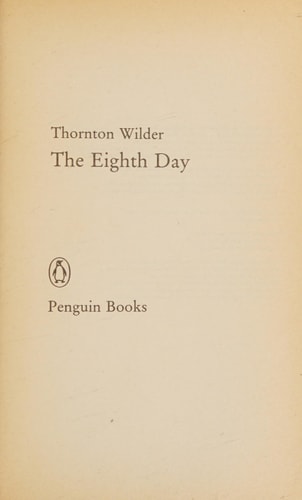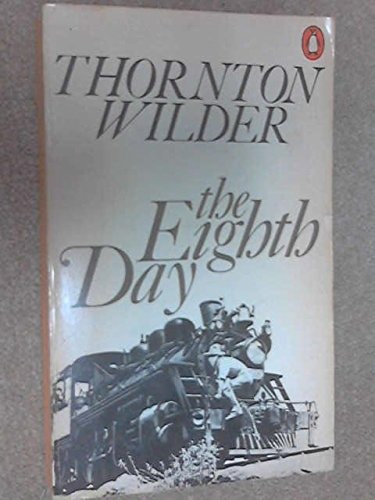
The Eighth Day
0
0
As an Amazon Associate and affiliate partner, Menrva Books earns from qualifying purchases. Learn more
Author Description
At the turn of the century, an Illinois man is sentenced to death for the murder of a close friend, but escapes to South America to build a new world for himself and his family. In 1962 and 1963, Thornton Wilder spent twenty months in hibernation, away from family and friends, in the town of Douglas, Arizona. While there, he launched The Eighth Day, a tale set in a mining town in southern Illinois about two families blasted apart by the apparent murder of one father by the other. The miraculous escape of the accused killer, John Ashley, on the eve of his execution and his flight to freedom triggers a powerful story tracing the fate of his, and the victim’s, wife and children. At once a murder mystery and a philosophical story, The Eighth Day is a work of classic stature that has been hailed as a great American epic.
Menrva's Summary
THE PULSE
The narrative is set in motion when John Ashley, a man convicted of murdering his close friend in a small Illinois mining town, miraculously escapes his execution and flees to South America. Following this inciting incident, the story tracks the divergent paths of the Ashley and Beata families as they navigate the social and economic fallout of the crime. The narrative framework employs a multi-generational perspective, examining how the lives of the wives and children are irrevocably altered by the shadow of the murder. The world is defined by the rigid social structures of the early 20th-century American Midwest and the harsh, transformative environment of the South American frontier.
INSIDE THE PAGES
- Multi-generational family saga structure
- Examination of moral ambiguity and guilt
- Setting contrast between Illinois mining culture and South American landscapes
- Philosophical inquiry into the nature of fate and free will
- Non-linear exploration of the murder's aftermath
- Focus on the resilience of the families left behind
- Detailed character studies of the accused and the victim's survivors
- Integration of mystery elements within a broader literary framework
THE COLLECTIVE ECHO
Discussion often centers on the expansive scope of the narrative and how Wilder balances the tension of a murder mystery with deep philosophical reflection. Readers frequently highlight the intricate development of the two families, noting that the plot prioritizes character evolution over the mechanics of the crime itself. Critics often point to the atmospheric world-building, which captures the distinct cultural shifts of the early 20th century with precision. The work is frequently analyzed for its thematic exploration of how individual actions ripple through generations, creating a complex web of consequences that define the characters' identities. Many readers find the pacing deliberate, favoring a slow-burn approach that allows for a thorough investigation of the human condition.
Page Count:
400
Publication Date:
1969-07-01
Publisher:
Penguin Books Ltd
ISBN-10:
0140028188
ISBN-13:
9780140028188
Historical Fiction
Literary Fiction
Mystery
American
Family Saga
Classics