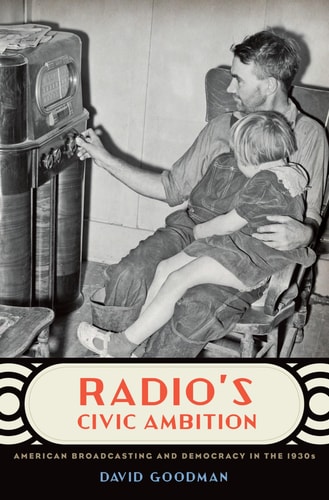
Radio's Civic Ambition: American Broadcasting and Democracy in the 1930s
0
0
As an Amazon Associate and affiliate partner, Menrva Books earns from qualifying purchases. Learn more
Author Description
The history of American radio broadcasting has often been written as a lament for lost possibilities, a tale of what might have been. One now familiar landmark in that account is the story of how American commercial broadcasters, in the passage of the 1934 Communications Act, won a great victory over reformers who wanted frequencies set aside for non-commercial use. It is generally agreed that the defeat of the radio reformers was decisive and permanent, and that the best hopes for a public radio in the United States had been thwarted by 1934. In Radio's Civic Ambition, however, author David Goodman focuses not on the lost possibilities and defeated reformers, but on what did happen as the beginning of another chapter in the story of the struggle over the meaning and purpose of American broadcasting. Commercial broadcasters paid a considerable price for their victory: in the years after 1934, American broadcasters always had to be seen to be providing public service as well as entertainment. An impressive range of programs, from imaginatively conceived classical music broadcasts to lively multi-opinion radio forums, was designed to promote civic engagement and individualization. By the later 1930s, political leaders, key social science and communications intellectuals, the Federal Communications Commission, and many articulate and educated ordinary Americans, increasingly expected commercial broadcasters in the US to perform a range of ambitious civic functions, including encouraging local community, strengthening democracy, fostering talent, and producing tolerance for other points of view.A new look at the history of commercial radio broadcasting in America, Radio's Civic Ambition will appeal to students and scholars in communications and radio studies, music history, media studies, and American history.
Menrva's Summary
THE THESIS
How did the American commercial broadcasting industry navigate the expectation to serve democratic and civic functions following the 1934 Communications Act? David Goodman examines the post-1934 landscape of American radio, challenging the narrative that the defeat of non-commercial reformers marked the end of public-interest broadcasting. By analyzing the interplay between commercial broadcasters, federal regulators, and social intellectuals, the author argues that the industry was forced to adopt a robust civic identity to maintain its legitimacy. The text synthesizes historical policy shifts with an analysis of programming content to demonstrate how radio became a central pillar of American public life during the 1930s.
THE SCOPE MAP
What You Will Find
- Analysis of the 1934 Communications Act and its long-term regulatory impact.
- Examination of diverse programming formats including classical music broadcasts and multi-opinion forums.
- Investigation into the influence of social science intellectuals and the Federal Communications Commission on broadcasting standards.
- Evaluation of the evolving relationship between commercial entertainment and the promotion of democratic tolerance and local community engagement.
THE AUTHORITY PERSPECTIVE
Scholars in media history and communications identify this work as a significant revisionist account that complicates the traditional binary of commercial versus public radio. Readers frequently note the meticulous research into the institutional pressures that shaped the golden age of American broadcasting.
Page Count:
368
Publication Date:
2011-04-12
Publisher:
Oxford University Press
ISBN-10:
0195394089
ISBN-13:
9780195394085
History
Communications
American History
Humanities
Music History
Radio Broadcasting
Broadcast History
Media Studies
Community Tags
Similar Books