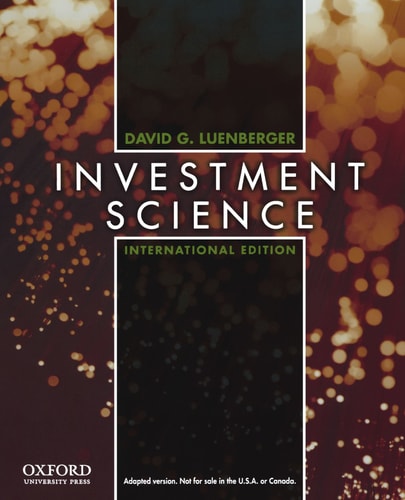
Investment Science
0
0
As an Amazon Associate and affiliate partner, Menrva Books earns from qualifying purchases. Learn more
Author Description
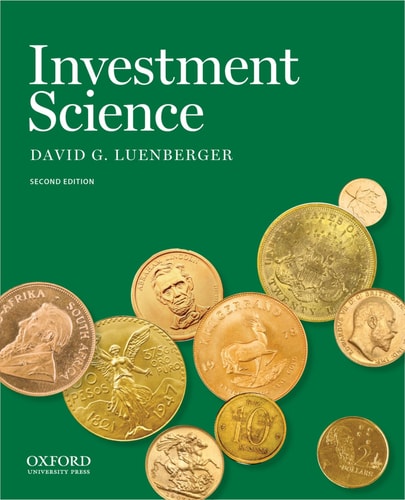
Representing a true breakthrough in the organization of finance topics, Investment Science will be an indispensable tool in teaching modern investment theory. It presents sound fundamentals and shows how real problems can be solved with modern, yet simple, methods. David Luenberger gives thorough yet highly accessible mathematical coverage of the standard and recent topics of introductory fixed-income securities, modern portfolio theory and capital asset pricing theory, derivatives (futures, options, and swaps), and innovations in optimal portfolio growth and valuation of multiperiod risky investments. Throughout the book, he uses mathematics to present essential ideas of investments and their applications in business practice. The creative use of binomial lattices to formulate and solve a wide variety of important finance problems is a special feature of the book. In moving from fixed-income securities to derivatives, Luenberger increases naturally the level of mathematical sophistication, but never goes beyond algebra, elementary statistics/probability, and calculus. He includes appendices on probability and calculus at the end of the book for student reference. Creative examples and end-of-chapter exercises are also included to provide additional applications of principles given in the text.
Menrva's Summary
THE THESIS
This text investigates the mathematical foundations of modern investment theory to provide a rigorous yet accessible framework for solving complex financial problems. David G. Luenberger, a professor of management science and engineering, synthesizes standard financial models with contemporary valuation techniques. By utilizing a consistent mathematical approach, the author bridges the gap between theoretical finance and practical business application, ensuring that students can apply quantitative methods to real-world market scenarios.
THE SCOPE MAP
What You Will Find
- Comprehensive coverage of fixed-income securities, portfolio theory, and capital asset pricing models.
- Detailed methodology for valuing derivatives, including futures, options, and swaps.
- Application of binomial lattices to solve multiperiod risky investment problems.
- Mathematical appendices covering essential probability and calculus for student reference.
THE AUTHORITY PERSPECTIVE
Experts and educators frequently cite this work as a foundational text for students seeking to understand the quantitative mechanics of finance. Readers often note the balance between mathematical rigor and the accessibility of the provided examples, making it a standard reference for introductory investment theory courses.
Page Count:
510
Publication Date:
2009-01-01
Publisher:
Oxford University Press
ISBN-10:
0195391063
ISBN-13:
9780195391060
Economics
textbook
Investment
Mathematics
Finance