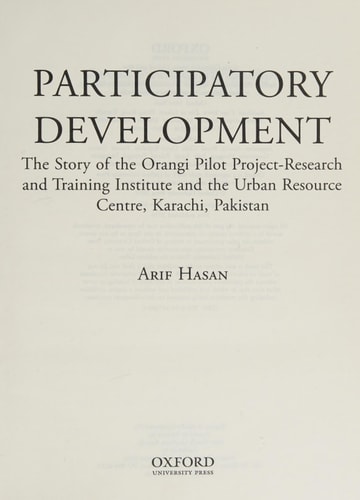
Participatory Development: The Story of the Orangi Pilot Project-Research and Training Institute and Urban Resource Centre, Karachi, Pakistan
0
0
As an Amazon Associate and affiliate partner, Menrva Books earns from qualifying purchases. Learn more
Author Description
The book is divided into three parts. Part one consists of a description (including statistics) of the poverty, environmental and community related national and the urban contexts within which these projects have been established.Part two is the story of the OPP-RTI, its origins, its culture and the evolution of its sanitation, housing and education programmes along with a description and evaluation of the processes, communities, NGOS, government agencies and donors involved in them and the principles and advocacy strategies that emerge out of the work of the OPP-RTI. The impact of the OPP-RTI's work, its policy implications and the views of its detractors also form a chapter of this part. Part three describes the work of the URC and the model of research, advocacy and consultation with the actors in the urban drama of Karachi so as to promote a more equitable and just model of urban development which benefits low income communities which form the vast majority of the city population.
Menrva's Summary
THE THESIS
This book investigates how community-led, participatory development models can effectively address systemic urban poverty and infrastructure deficits in rapidly growing cities. Arif Hasan, a prominent architect and urban planner, utilizes his extensive field experience and research in Karachi to argue that small-scale, locally managed initiatives often outperform top-down government interventions. By documenting the evolution of the Orangi Pilot Project and the Urban Resource Centre, the author provides a framework for scaling grassroots solutions to complex urban challenges.
THE SCOPE MAP
What You Will Find
- Detailed analysis of sanitation, housing, and education programs in Karachi.
- Evaluation of the interactions between NGOs, government agencies, and local communities.
- Primary source data regarding urban poverty and environmental conditions.
- Advocacy strategies for promoting equitable urban development models.
THE AUTHORITY PERSPECTIVE
Experts in urban development recognize this work as a foundational case study for understanding the mechanics of participatory planning in the Global South. Readers frequently note the practical, evidence-based approach Hasan takes in documenting the successes and policy challenges of the Orangi Pilot Project.
Page Count:
325
Publication Date:
2010-02-28
Publisher:
Oxford University Press
ISBN-10:
0195476891
ISBN-13:
9780195476897
Non-governmental organizations
urban planning
Public Policy
Pakistan
Cities And Towns
Sociology
Community Tags
Similar Books