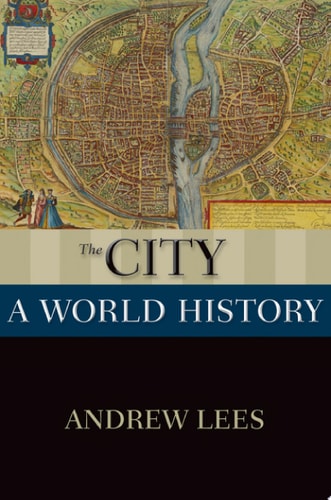
The City: A World History
0
0
As an Amazon Associate and affiliate partner, Menrva Books earns from qualifying purchases. Learn more
Author Description
The City: A World History tells the story of the rise and development of urban centers from ancient times to the twenty-first century. It begins with the establishment of the first cities in the Near East in the fourth millennium BCE, and goes on to examine urban growth in the Indus River Valley in India, as well as Egypt and areas that bordered the Mediterranean Sea. Athens, Alexandria, and Rome stand out both politically and culturally. With the fall of the Roman Empire in the West, European cities entered into a long period of waning and deterioration. But elsewhere, great cities-among them, Constantinople, Baghdad, Chang'an, and Tenochtitlán-thrived. In the late Middle Ages and the Early Modern period, urban growth resumed in Europe, giving rise to cities like Florence, Paris, and London. This urban growth also accelerated in parts of the world that came under European control, such as Philadelphia in the nascent United States.As the Industrial Revolution swept through in the nineteenth century, cities grew rapidly. Their expansion resulted in a slew of social problems and political disruptions, but it was accompanied by impressive measures designed to improve urban life. Meanwhile, colonial cities bore the imprint of European imperialism. Finally, the book turns to the years since 1914, guided by a few themes: the impact of war and revolution; urban reconstruction after 1945; migration out of many cities in the United States into growing suburbs; and the explosive growth of "megacities" in the developing world.
Menrva's Summary
THE THESIS
How have urban centers evolved from ancient settlements to the complex, sprawling megacities of the twenty-first century? Andrew Lees, a historian specializing in urban development, provides a comprehensive chronological analysis of the city as a human construct. By synthesizing historical data across diverse civilizations—from the Near East to the modern industrial West—he argues that the city serves as a primary engine for political, cultural, and social transformation throughout human history.
THE SCOPE MAP
What You Will Find
- A chronological survey of urban development from the fourth millennium BCE to the present day.
- Comparative analysis of urban growth patterns in the Mediterranean, Asia, and the Americas.
- Examination of the impact of the Industrial Revolution on urban infrastructure and social organization.
Scope Limits
- The text focuses primarily on macro-historical trends rather than granular architectural or local histories of every major city.
- It does not provide an exhaustive study of rural-urban migration patterns in every specific developing nation.
THE AUTHORITY PERSPECTIVE
Scholars and students of urban history frequently cite this work as a balanced, accessible introduction to the global development of cities. Experts highlight the author's ability to synthesize vast historical periods into a coherent narrative that remains grounded in academic rigor.
Page Count:
160
Publication Date:
2015-01-01
Publisher:
Oxford University Press
ISBN-10:
0190267429
ISBN-13:
9780190267421
History
Urban Studies
Sociology
Cities And Towns
World Civilization
Public Policy
Geography
Special Topics
World history
Community Tags
Similar Books