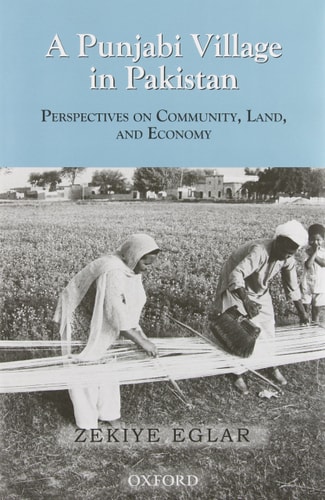
A Punjabi Village in Perspective
0
0
As an Amazon Associate and affiliate partner, Menrva Books earns from qualifying purchases. Learn more
Author Description
The two volumes, the award-winning A Punjabi Village in Pakistan and The Economic Life of a Punjabi Village are based on extensive fieldwork in Pakistan and contain relevant insights into Pakistani society, particularly women, still pertinent today, as well as a more holistic and humanistic view of village life. Eglar's study is useful for precisely what she focused on--the patterns of ritual service and gift exchange which underlay every facet of life in the village.Together the two books present an in-depth outsider-insider perspective into the social and economic patterns of a village in Pakistan prior to the Green Revolution of 1958 which heralded the beginnings of change in village agriculture and land ownership.Of particular advantage to the research was the fact that Eglar's sources of information were not limited to one or the other gender. As a guest of the Chowdhry family she could initially stay in the baithak (guest house), traditionally an all-male preserve situated close to the main house where villagers would gather over a smoke and chat after their day's work. In addition, as a woman, she could freely enter the women's domain and participate in and observe their daily activities.In her work, Eglar found unwritten social contracts and relationships known as vartan bhanji that bound the community at different levels. The well-established networking patterns of vartan bhanji cemented relationships within the family. These patterns then extended beyond the family to the wider village community and further, to other villages in the area. The unwritten code also sustained professional relationships between the landowning zamindars, the tenant farmers and the kammis (literally, 'those who work', people in service professions). Vartan bhanji in the male domain revolved around farming and its associated trades, with various reciprocal exchanges moving the economy along, rather than cash payments. However, women played a central role. It is this dual aspect th
Menrva's Summary
THE THESIS
What social and economic mechanisms governed the stability and cohesion of a Punjabi village in Pakistan prior to the 1958 Green Revolution? Zekiya Suleyman Eglar, an anthropologist with unique access to both male and female spheres of village life, investigates the intricate systems of ritual service and gift exchange that defined rural existence. Her work argues that the unwritten social contract known as vartan bhanji served as the primary framework for maintaining professional and personal relationships across different social strata, including landowners, tenants, and service workers.
THE SCOPE MAP
What You Will Find
- Detailed analysis of the vartan bhanji system of reciprocal gift exchange and social obligation.
- Comparative study of gendered domains, contrasting the male-dominated agricultural sphere with the female-centered domestic and social networks.
- Historical documentation of rural economic structures before the modernization brought by the Green Revolution.
- Examination of the professional relationships between zamindars and kammis within a non-cash, service-based economy.
THE AUTHORITY PERSPECTIVE
Scholars and anthropologists frequently cite this work as a foundational text for understanding the social fabric of rural Pakistan before the onset of rapid industrialization. Readers often note the academic density of the prose, which provides a comprehensive and humanistic view of village life that remains relevant for contemporary sociological research.
Page Count:
350
Publication Date:
2010-06-01
Publisher:
Oxford University Press
ISBN-10:
0195477235
ISBN-13:
9780195477238
Economics
Pakistan
Anthropology
Gender Studies
Rural Studies
Social Life
Sociology
Community Tags
Similar Books