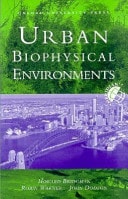
Urban Biophysical Environments
0
0
As an Amazon Associate and affiliate partner, Menrva Books earns from qualifying purchases. Learn more
Author Description
At present over 80 percent of Australia's population lives in urban areas. This percentage is likely to increase as cities expand in an attempt to keep up with the growth in population. Australia is not unique in this situation. Increasing urbanization is the prognosis for countries all over the globe. Despite their youth, Australian cities share many characteristics and problems with cities elsewhere, along with a localized set of difficulties that requires specific solutions. Urban development in Australia has had a major impact on surrounding biophysical environments, and this can sometimes adversely affect the health, welfare and lifestyle of urban residents. Urban Biophysical Environments provides an assessment of current and emerging environmental problems from a physical point of view. The authors take a multi-disciplinary approach to understanding and managing the impact of cities on the atmosphere, climate, surface water and groundwater, soil, flora and fauna, and ecosystems of Australia. By emphasizing the depth and range of potential problems, this book makes an ideal text for students in environmental, geographical, or atmospheric sciences.
Menrva's Summary
THE THESIS
This book investigates the physical environmental consequences of rapid urbanization in Australia and the multi-disciplinary strategies required to manage these impacts. The authors, Howard Bridgman, John Dodson, and Robin Warner, utilize a synthesis of geographical and environmental data to examine how city expansion alters natural systems. They argue that understanding the biophysical constraints of urban areas is critical for maintaining the health and welfare of growing populations in both Australian and global contexts.
THE SCOPE MAP
What You Will Find
- Analysis of urban impacts on atmosphere, climate, and local weather patterns.
- Assessment of hydrological changes affecting surface water and groundwater systems.
- Evaluation of soil degradation and the loss of urban flora and fauna.
- Methodologies for managing ecosystems within densely populated urban environments.
THE AUTHORITY PERSPECTIVE
Experts identify this text as a foundational resource for students in environmental and geographical sciences due to its specific focus on the Australian urban landscape. Readers frequently note the technical clarity with which the authors bridge the gap between physical science and urban planning policy.
Page Count:
166
Publication Date:
1996-05-02
Publisher:
Oxford University Press
ISBN-10:
0195536118
ISBN-13:
9780195536119
Geography
Atmospheric Science
Human ecology
Ecology
Australia
urban planning
Community Tags
Similar Books