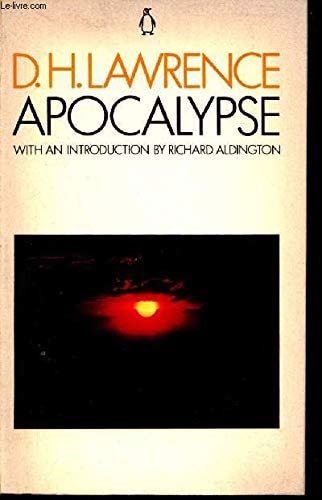
Apocalypse
0
0
As an Amazon Associate and affiliate partner, Menrva Books earns from qualifying purchases. Learn more
Author Description
Written during the winter of 1929-30 and his last major work, Apocalypse is Lawrence's radical criticism of the political, religious and social structures that have shaped Western civilization. In his view the perpetual conflict within man, in which emotion, instinct and the senses vie with the intellect and reason, has resulted in society's increasing alienation from the natural world. Yet Lawrence's belief in humanity's power to regain the imaginative and spiritual values which alone can revitalize our world also makes Apocalypse a powerful statement of hope. Presenting his thoughts on psychology, science, politics, art, God and man, and including a fierce protest against Christianity, Apocalypse is Lawrence's last testament, his final attempt to convey his vision of man and of the cosmos.
Menrva's Summary
THE THESIS
How can humanity reconcile the conflict between instinctual nature and the rigid structures of Western civilization to achieve spiritual revitalization? Written during the final months of his life, D.H. Lawrence examines the historical and psychological forces that have alienated modern man from the natural world. He argues that the dominance of intellect and reason over sensory experience has led to a societal decline, proposing a return to imaginative and spiritual values as the only path toward restoration.
THE SCOPE MAP
What You Will Find
- A critical analysis of the Book of Revelation and its influence on Western religious thought
- Philosophical inquiries into the intersection of psychology, politics, and art
- A critique of institutional Christianity and its impact on human instinct
Scope Limits
- The text does not provide a systematic or empirical scientific study of the topics discussed
- It does not offer a structured political manifesto or policy proposal
THE AUTHORITY PERSPECTIVE
Scholars often categorize this work as a vital, albeit idiosyncratic, final testament that encapsulates Lawrence's lifelong preoccupation with the tension between the individual and society. Readers frequently note the intense, polemical nature of the prose, which serves as both a cultural critique and a deeply personal philosophical statement.
Page Count:
160
Publication Date:
1977-01-27
Publisher:
Penguin Books
ISBN-10:
0140038566
ISBN-13:
9780140038569
Religion
Philosophy
Non-Fiction
Social Commentary
Literary Criticism
Community Tags
Similar Books