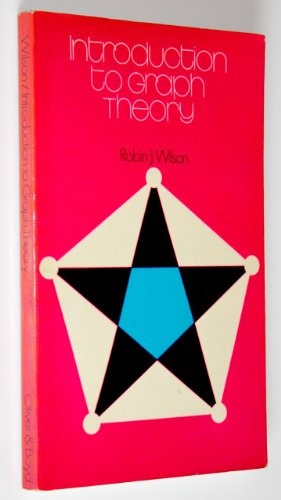
Introduction to Graph Theory
0
0
As an Amazon Associate and affiliate partner, Menrva Books earns from qualifying purchases. Learn more
Author Description
Graph Theory has recently emerged as a subject in its own right, as well as being an important mathematical tool in such diverse subjects as operational research, chemistry, sociology and genetics. Robin Wilson's book has been widely used as a text for undergraduate courses in mathematics, computer science and economics, and as a readable introduction to the subject for non-mathematicians.The opening chapters provide a basic foundation course, containing such topics as trees, algorithms, Eulerian and Hamiltonian graphs, planar graphs and colouring, with special reference to the four-colour theorem. Following these, there are two chapters on directed graphs and transversal theory, relating these areas to such subjects as Markov chains and network flows. Finally, there is a chapter on matroid theory, which is used to consolidate some of the material from earlier chapters.For this new edition, the text has been completely revised, and there is a full range of exercises of varying difficulty. There is new material on algorithms, tree-searches, and graph-theoretical puzzles. Full solutions are provided for many of the exercises.Robin Wilson is Dean and Director of Studies in the Faculty of Mathematics and Computing at the Open University.
Menrva's Summary
THE THESIS
This text investigates the fundamental principles and applications of graph theory as a distinct mathematical discipline. Robin J. Wilson, a prominent academic in mathematics and computing, utilizes a structured pedagogical approach to introduce core concepts. The book synthesizes theoretical foundations with practical applications in fields such as operational research, sociology, and genetics to demonstrate the utility of graph-based modeling.
THE SCOPE MAP
What You Will Find
- Foundational topics including trees, algorithms, and planar graphs
- Advanced concepts such as directed graphs, transversal theory, and matroid theory
- Practical exercises of varying difficulty with provided solutions
Scope Limits
- The text focuses on introductory and intermediate concepts rather than exhaustive research-level proofs
- It does not cover highly specialized or niche applications beyond the primary fields mentioned
THE AUTHORITY PERSPECTIVE
Experts and educators frequently cite this work as a foundational text for undergraduate mathematics and computer science curricula. Readers often note the clarity of the prose and the effectiveness of the exercises in reinforcing complex theoretical concepts.
Page Count:
168
Publication Date:
1972-07-31
Publisher:
Oliver & B
ISBN-10:
0050025341
ISBN-13:
9780050025345
Applied
Mathematics
textbook
Computer Science
Graph Theory
Academic
Community Tags
Other Editions(3)
Similar Books