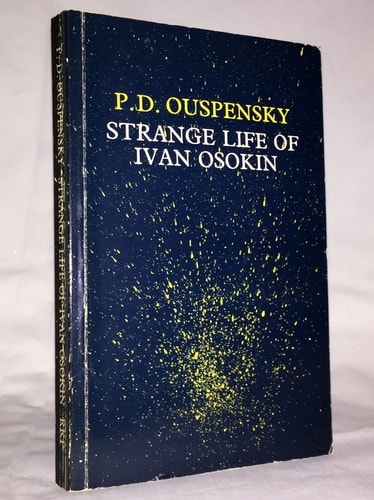
The Strange Life of Ivan Osokin
0
0
As an Amazon Associate and affiliate partner, Menrva Books earns from qualifying purchases. Learn more
Author Description
At the time he wrote Strange Life of Ivan Osokin, P.D. Ouspensky was already an acclaimed author and thinker, with such major works as Tertium Organum and The Fourth Dimension to his credit. In Ivan Osokin, Ouspensky sets out to explore the idea of ‘eternal recurrence’, the theory that most humans are condemned to an infinite repetition of a single lifetime, making the same mistakes and facing the same triumphs and tragedies each time.The eponymous hero is a feckless youth, prone to pointless rebellion and easily bored. He changes little as he grows to manhood, wasting his future, squandering his inheritance and losing the woman he loves. In this parlous state, and contemplating suicide, Ivan Osokin meets a magician who agrees to send him back to attempt a conscious repetition of his life without mistakes, at the same time warning him that it will make not the slightest alteration to the outcome. Undaunted, Ivan Osokin undergoes the ritual and relives his earlier existence – with a strange and unexpected result.
Menrva's Summary
THE PULSE
A disillusioned man is granted the opportunity to relive his life by a mysterious magician, only to discover the rigid constraints of his own nature. Ivan Osokin, a young man defined by his impulsive rebellion and inability to learn from his failures, finds himself at the precipice of self-destruction. After squandering his inheritance and losing his romantic interest, he encounters a magician who offers him a chance to return to his youth to correct his past errors. The narrative follows Osokin as he attempts to navigate his life a second time, constrained by the deterministic belief that human character remains static regardless of the circumstances. The story functions as a philosophical exploration of the concept of eternal recurrence, presented through a linear but reflective narrative framework.
INSIDE THE PAGES
- Exploration of the theory of eternal recurrence
- Deterministic character development
- Magical realism elements
- Philosophical dialogue regarding free will
- Examination of human repetition and habit
- First-person and third-person narrative shifts
- Symbolic representation of the magician as a catalyst for self-reflection
- Focus on the futility of attempting to alter one's inherent nature
THE COLLECTIVE ECHO
Readers and critics often identify this work as a narrative extension of Ouspensky’s broader philosophical inquiries into time and consciousness. Discussion frequently centers on the tension between the protagonist’s desire for change and the author’s bleak assertion that character is destiny. Many observers highlight the book’s effectiveness in translating abstract metaphysical concepts into a tangible, albeit somber, narrative experience. The pacing is noted for its deliberate, contemplative quality, which prioritizes thematic weight over traditional plot progression. Readers often conclude that the text serves as a provocative meditation on the limitations of human agency within a cyclical existence.
Page Count:
0
Publication Date:
1972-01-30
Publisher:
Penguin Books
ISBN-10:
0140033661
ISBN-13:
9780140033663
Fantasy
Metaphysical
Contemporary
Philosophical
classic
Community Tags
Similar Books