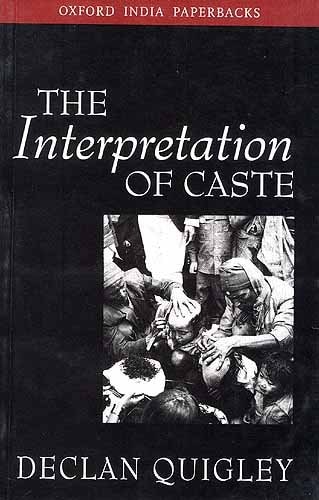
The Interpretation of Caste
0
0
As an Amazon Associate and affiliate partner, Menrva Books earns from qualifying purchases. Learn more
Author Description
This book provides a radical alternative to prevailing theories of caste which either build on indigenous rationalizations of the Brahman's supremacy or reduce hierarchy to material factors. Drawing on a wide range of historical and ethnographic sources as well as four years' fieldwork, Declan Quigley proposes a comparative approach which locates caste-organized communities in the context of complex agrarian societies generally. At the heart of caste, he argues, there is a tension between the centralizing forces of kingship, with its associated ritual, and decentralizing forces of kinship. Dr Quigley believes that it is this tension, rather than Brahminincal ideology, which generates the characteristic patterns of hierarchy and the preoccupation with purity and pollution. In making kingship central to the explanation of caste proposed by A M Hocart over half a century ago, and offers an elegant and wide-ranging comparative interpretation of facts which have until now eluded satisfactory explanation.
Menrva's Summary
THE THESIS
This book investigates the fundamental drivers of the caste system by challenging traditional theories that rely solely on Brahmanical ideology or materialist reductionism. Declan Quigley, an anthropologist, utilizes four years of fieldwork alongside historical and ethnographic data to construct a new framework. He argues that the core of the caste system is defined by a structural tension between the centralizing forces of kingship and the decentralizing forces of kinship, rather than purely religious hierarchy.
THE SCOPE MAP
What You Will Find
- A comparative analysis of caste-organized communities within complex agrarian societies.
- A re-evaluation of A. M. Hocart’s theories regarding the centrality of kingship in social hierarchy.
- Examination of the relationship between ritual, purity, and pollution as products of political tension.
- Synthesis of historical records and contemporary ethnographic fieldwork conducted in India.
THE AUTHORITY PERSPECTIVE
Scholars and anthropologists recognize this work as a significant contribution to the theoretical debate surrounding caste, noting its ability to bridge the gap between specialized academic discourse and general interest. Reviewers frequently highlight the clarity of Quigley's arguments and his success in providing a robust alternative to established sociological paradigms.
Page Count:
196
Publication Date:
2000-01-01
Publisher:
OUP India
ISBN-10:
0195651715
ISBN-13:
9780195651713
Anthropology
Social History
India
Sociology
Caste