Chocky
0
0
As an Amazon Associate and affiliate partner, Menrva Books earns from qualifying purchases. Learn more
Author Description
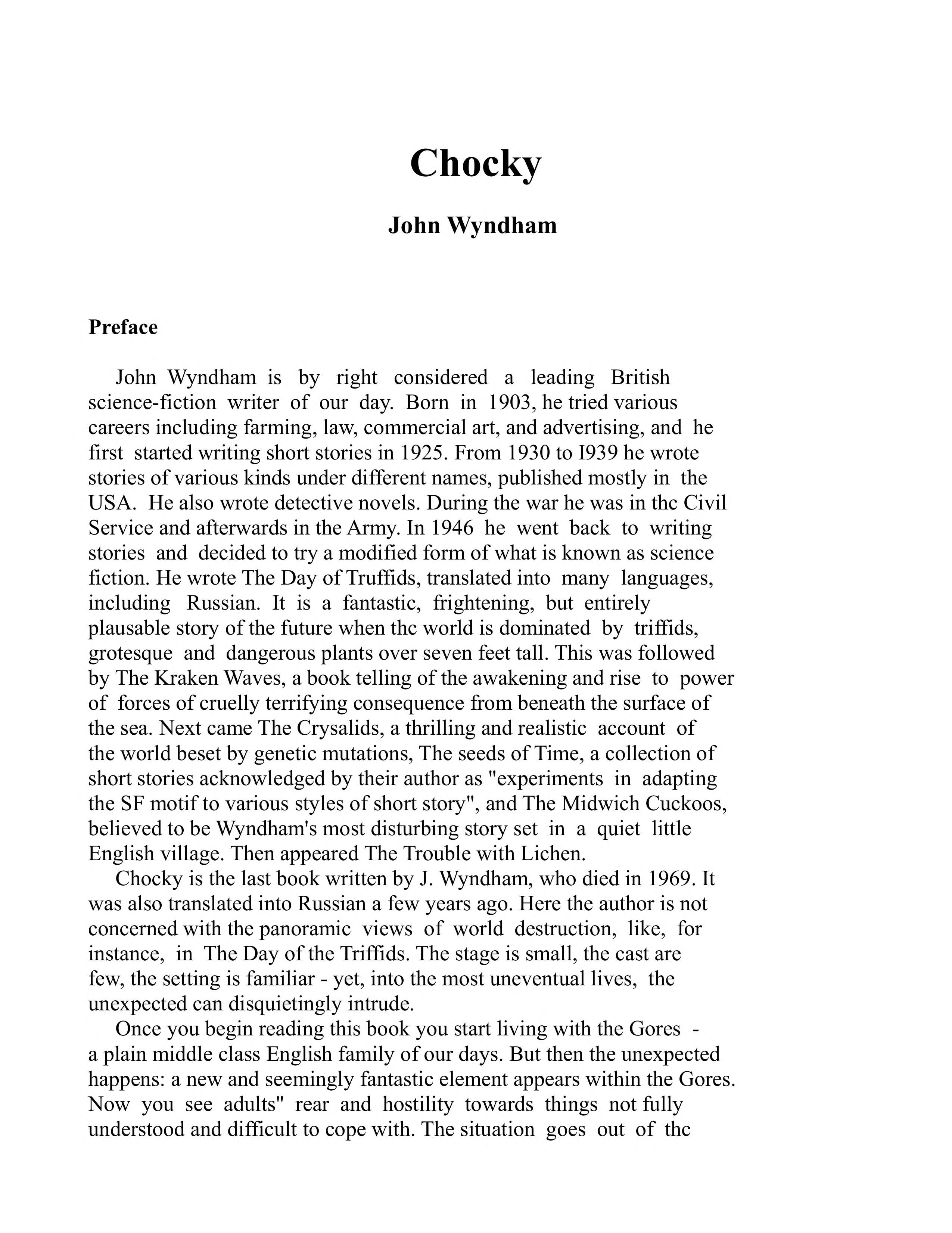
In Chocky, pioneering science-fiction master John Wyndham confronts an enigma as strange as anything found in his classic works The Day of the Triffids or The Chrysalids--the mind of a child. It's not terribly unusual for a boy to have an imaginary friend, but Matthew's parents have to agree that his--nicknamed Chocky--is anything but ordinary. Why, Chocky demands to know, are there twenty-four hours in a day? Why are there two sexes? Why can't Matthew solve his math homework using a logical system like binary code? When the questions Chocky asks become too advanced and, frankly, too odd for teachers to answer, Matthew's parents start to wonder if Chocky might be something far stranger than a figment of their son's imagination. Chocky, the last novel Wyndham published during his life, is a playful investigation of what being human is all about, delving into such matters as child-rearing, marriage, learning, artistic inspiration--and ending with a surprising and impassioned plea for better human stewardship of the earth.
Menrva's Summary
THE PULSE
When a young boy begins communicating with an unseen entity named Chocky, his parents must determine if the presence is a harmless imaginary friend or an external intelligence. Matthew, a typical school-aged boy, finds his daily life disrupted by the persistent, probing questions of an entity that possesses knowledge far beyond his years. His parents, initially dismissive, are forced to confront the reality of the situation as Matthew displays advanced mathematical and artistic capabilities that defy explanation. The narrative unfolds through a grounded, domestic lens, emphasizing the tension between mundane family life and the intrusion of an inexplicable phenomenon.
INSIDE THE PAGES
- First-person narrative perspective from the father
- Domestic setting contrasting with speculative elements
- Exploration of child development and parental anxiety
- Philosophical inquiries into human biology and social structures
- Gradual escalation of the central mystery
- Focus on the nature of consciousness and intelligence
- Integration of environmental and stewardship themes
- Minimalist approach to science fiction tropes
THE COLLECTIVE ECHO
Readers frequently highlight the understated, conversational tone that distinguishes this work from more action-oriented science fiction. Discussion often centers on the effectiveness of the domestic setting in grounding the more speculative elements of the plot. Critics often note the author's ability to balance the mystery of the entity with a sincere examination of parental responsibility and human potential. Many find the conclusion particularly thought-provoking, as it shifts the focus toward broader societal concerns regarding the future of humanity. The narrative is widely regarded as a subtle, character-driven exploration of the unknown rather than a traditional thriller.
Page Count:
153
Publication Date:
1972-01-01
Publisher:
Penguin Books
ISBN-10:
0140031219
ISBN-13:
9780140031218
Science Fiction
Fantasy
Fiction
Suspense
Science Fiction
Exploration
classic
Psychological
Adventure
Speculative Fiction
Classics
Mystery Thriller & Suspense