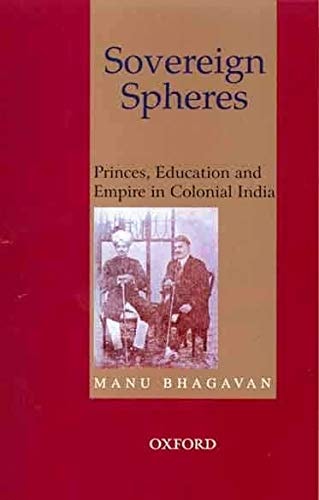
Sovereign Spheres: Princes, Education, and Empire in Colonial India
0
0
As an Amazon Associate and affiliate partner, Menrva Books earns from qualifying purchases. Learn more
Author Description
Princely states were semi-autonomous territories that made up roughly 40 per cent of South Asia under British rule. This engaging study looks at educational reform in the context of debates on modernity and anti-colonial nationalism in the two leading progressive princely states in twentieth-century India, Baroda and Mysore.Sovereign Spheres explores the ways in which colonial authority was challenged and negotiated through both direct political action and more subtle, long-term initiatives involving social and cultural reform. In the process, the book furthers our understanding of domination and resistance and forces us to rethink our notions of the heretofore largely ignored princely states. These regions were central not only to the ideology of empire, but to nationalist visions of postcoloniality as well. In examining the role of princely state universities in the production of modern, governable subjects, the author interrogates the nature of public and private domains in the subcontinent and argues for a fundamental remodelling of colonial India.Ground-breaking and authoritative, this book will be of importance not just to researchers of South Asian history, but to scholars and students of power dynamics, social reform movements, state formation, and to all those interested in comparative understandings of imperialism, nationalism, and modernity.
Menrva's Summary
THE THESIS
This book investigates how educational reform in the princely states of Baroda and Mysore functioned as a site for negotiating colonial authority and shaping modern nationalist identity in twentieth-century India. Manu Bhagavan, a scholar of South Asian history, utilizes archival research and political analysis to examine how these semi-autonomous regions navigated the pressures of British imperialism. The author argues that these states were not peripheral to the colonial experience but were central to the development of modern governance and postcolonial nationalist visions. By analyzing the role of universities, the text interrogates the boundaries between public and private domains and the construction of the modern subject.
THE SCOPE MAP
What You Will Find
- Analysis of educational reform policies in Baroda and Mysore during the twentieth century.
- Examination of the intersection between modernity, anti-colonial nationalism, and imperial power dynamics.
- Historical investigation into the administrative and social structures of semi-autonomous princely states.
- Theoretical framework regarding the production of governable subjects within colonial and postcolonial contexts.
THE AUTHORITY PERSPECTIVE
Scholars recognize this work as a significant contribution to the study of Indian princely states, often citing its focus on the intellectual and institutional history of the region. Readers frequently note the academic density of the prose, which provides a rigorous examination of state formation and power dynamics for researchers in the field.
Page Count:
219
Publication Date:
2003-03-27
Publisher:
Oxford University Press
ISBN-10:
0195663993
ISBN-13:
9780195663990
History
Vadodara India
Political Aspects
Education
Mysore India
Sociology
Colonialism
Community Tags
Similar Books