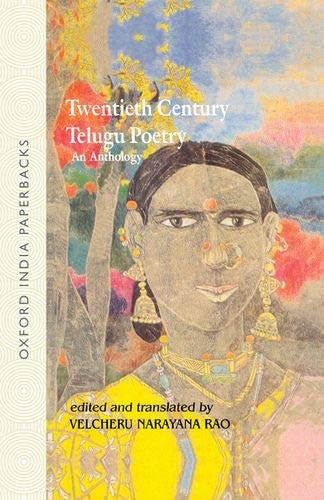
Twentieth Century Telugu Poetry: An Anthology
0
0
As an Amazon Associate and affiliate partner, Menrva Books earns from qualifying purchases. Learn more
Author Description
Velcheru Narayana Rao, Krishnadevaraya Professor of Languages and cultures of Asia at the University of Wisconsin-Madison, has a Lifelong and intimate connection to contemporary Telugu literary movements. Every time I have written anything about Telugu for a non-Telugu audience I have begun by saying Telugu is the second most widely spoken language in India, spoken by about 70 million people in the southern state of Andhra Pradesh. I hope this anthology will not need such an explanatory note. Poetry stands in its own right; it does not depend on geographic and demographic support for attention. However, poetry is made of words and words are located in language. It is, therefore, necessary to say that Telugu is a south Indian language with a vocabulary derived from Dravidian as well as Sanskrit sources and it has almost a thousand years of un-interrupted literary tradition. It is a highly musical language, and all poetry in it was written in metre until the later half of the twentieth century when free verse became popular. A hundred years is a significant period in the history of any literature, even if the literature has been in existence for almost a thousand years before. The last hundred years in Telugu literature have been especially revolutionary since they witnessed events of extraordinary significance in the political and cultural history of Andhra. For one thing, Telugu came into powerful contact with English under British colonial rule. Had it not been for the cataclysmic changes that took place in the cultural life of the country, the turn of the twentieth century in Telugu literature would have been a less eventful continuation of the new literary modes that began two centuries before.
Menrva's Summary
THE THESIS
This anthology investigates the evolution and transformation of Telugu poetry throughout the twentieth century, a period marked by significant political and cultural shifts. Velcheru Narayana Rao, a distinguished professor of languages and cultures of Asia, utilizes his extensive academic background to curate a selection that reflects the transition from traditional metrical forms to the emergence of free verse. The text argues that these poetic shifts are intrinsically linked to the broader historical context of Andhra Pradesh and the influence of colonial contact with English literature.
THE SCOPE MAP
What You Will Find
- A comprehensive collection of twentieth-century Telugu poems translated for a non-Telugu audience.
- Analysis of the shift from traditional metrical structures to modern free verse.
- Historical context regarding the impact of British colonial rule on regional literary modes.
- Examination of the linguistic roots of Telugu, drawing from both Dravidian and Sanskrit sources.
THE AUTHORITY PERSPECTIVE
Scholars and literary critics recognize this anthology as a foundational resource for understanding the modernization of Telugu literature. Readers frequently note the clarity of the historical framing, which makes the complex evolution of these poetic movements accessible to those unfamiliar with the regional language.
Page Count:
330
Publication Date:
2004-04-01
Publisher:
Oxford University Press
ISBN-10:
0195670191
ISBN-13:
9780195670196
Poetry
Anthology
Literary Criticism
Subjects
Asian
Indian
Community Tags
Similar Books