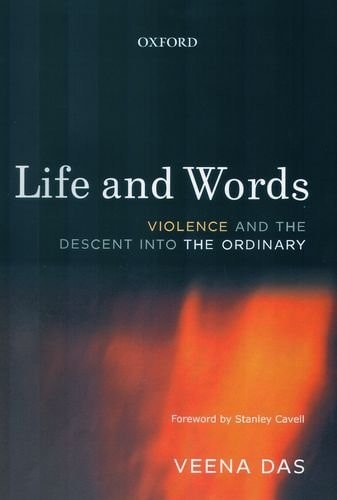
Life and Words: Violence and the Descent into the Ordinary
0
0
As an Amazon Associate and affiliate partner, Menrva Books earns from qualifying purchases. Learn more
Author Description
This is a powerful work by one of anthropology's most distinguished ethnographers. Veena Das weaves together rich fieldwork with a compelling critical analysis to make a significant contribution to contemporary thinking about violence and how it affects everyday life. The book is based on two events—the Partition of India in 1947 and the massacre of Sikhs in 1984 after the assassination of Indira Gandhi. The aim of the book is not to describe the moments of horror. Rather, it talks of what happens to the subjects and their world when the memories of such events unfold in their everyday lives. Two concepts that are knotted together in various ways in the chapters are those of the voice and the everyday. Das shows how the extreme violence of these events has entered 'the recesses of the ordinary'. She also shows how victims of such devastation become voiceless—not in the sense that they do not have words—but that these words become frozen, numb, and without life. Drawing from and engaging with the work of philosophers like Ludwig Wittgenstein, Gilles Deleuze, and Stanley Cavell, the study masters social history and philosophical reasoning. Through anthropological and philosophical reflections, it explores a new way of interpreting violence in societies and cultures around the globe as we strive to understand our world better.
Menrva's Summary
THE THESIS
This work investigates how extreme collective violence permeates and alters the fabric of everyday life for survivors long after the initial events have passed. Veena Das, a distinguished ethnographer, utilizes her extensive fieldwork and deep engagement with philosophical traditions to examine the aftermath of the 1947 Partition of India and the 1984 anti-Sikh riots. By bridging the gap between social history and philosophical inquiry, she argues that violence does not merely exist as a singular event but becomes embedded in the mundane, often rendering the voices of victims frozen or numb within their own lived experiences.
THE SCOPE MAP
What You Will Find
- Ethnographic analysis of the 1947 Partition of India and the 1984 anti-Sikh riots.
- Philosophical frameworks derived from the works of Ludwig Wittgenstein, Gilles Deleuze, and Stanley Cavell.
- Examination of the concept of the 'everyday' as a site where trauma is processed or suppressed.
- Qualitative research focusing on the intersection of language, memory, and social suffering.
THE AUTHORITY PERSPECTIVE
Scholars and anthropologists frequently cite this text as a foundational study for understanding the long-term social and psychological impacts of political violence. Readers often note the high level of academic density, as the prose requires a familiarity with both ethnographic methodology and continental philosophy to fully grasp the author's arguments.
Page Count:
0
Publication Date:
2007-01-18
Publisher:
Oxford University Press
ISBN-10:
0195687582
ISBN-13:
9780195687583
Philosophy
History
Politics
Asia
India
Social History
Anthropology
Sociology
Community Tags
Similar Books