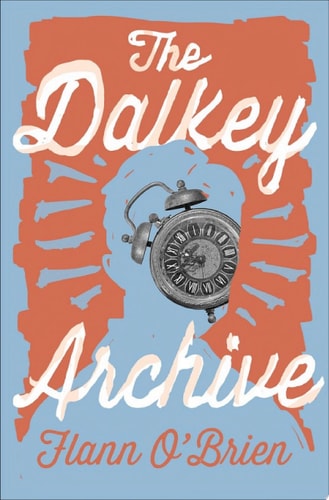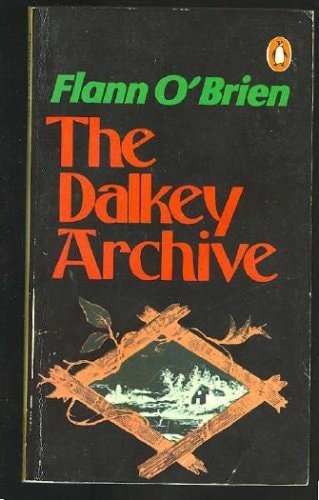
The Dalkey Archive
0
0
As an Amazon Associate and affiliate partner, Menrva Books earns from qualifying purchases. Learn more
Author Description
Hailed as "the best comic fantasy since Tristram Shandy " upon its publication in 1964, The Dalkey Archive is Flann O'Brien's fifth and final novel; or rather (as O'Brien wrote to his editor), "The book is not meant to be a novel or anything of the kind but a study in derision, various writers with their styles, and sundry modes, attitudes and cults being the rats in the cage." Among the targets of O'Brien's derision are religiosity, intellectual abstractions, J. W. Dunne's and Albert Einstein's views on time and relativity, and the lives and works of Saint Augustine and James Joyce, both of whom have speaking parts in the novel. Bewildering? Yes, but as O'Brien insists, "a measure of bewilderment is part of the job of literature."
Menrva's Summary
THE PULSE
The narrative centers on a man who discovers a mad scientist living in a cave near Dalkey, Ireland, who possesses the power to destroy the world. The protagonist, Mick Shaughnessy, seeks to understand the motivations of this scientist, De Selby, who intends to evaporate the world using a substance called DMP. The story operates within a framework of philosophical absurdity, where the protagonist must navigate the bizarre logic of a world where historical figures like Saint Augustine and James Joyce are resurrected or manipulated. The narrative structure is non-linear and relies heavily on dialogue-driven encounters that challenge the reader's perception of reality and time.
INSIDE THE PAGES
- Satirical treatment of intellectual and religious figures
- Metafictional commentary on the nature of authorship
- Incorporation of pseudo-scientific theories regarding time and relativity
- Inclusion of historical figures as active, speaking characters
- Use of irony and derision as primary narrative tools
- Stylistic mimicry of various literary voices
- Absurdist humor centered on Irish provincial life
- Philosophical inquiry into the nature of existence and reality
THE COLLECTIVE ECHO
Discussion often centers on the author's unique ability to blend high-concept philosophical debate with low-brow slapstick humor. Readers frequently highlight the chaotic pacing and the deliberate lack of traditional plot resolution as defining characteristics of the work. Critics often note that the novel functions more as a series of intellectual provocations than a cohesive story, which can be polarizing for those seeking conventional narrative arcs. The text is widely regarded as a challenging piece of metafiction that rewards those familiar with the specific literary and historical targets O'Brien lampoons. Ultimately, the work remains a significant example of mid-century experimental writing that prioritizes stylistic play over structural consistency.
Page Count:
222
Publication Date:
1977-09-29
Publisher:
Penguin Books
ISBN-10:
0140045163
ISBN-13:
9780140045161
Literary Fiction
Fiction
Fantasy
Satire
Experimental
Dark Humor
Humor & Satire
Literature & Fiction
Contemporary
Metafiction
Absurdist