All About H. Hatterr
0
0
As an Amazon Associate and affiliate partner, Menrva Books earns from qualifying purchases. Learn more
Author Description
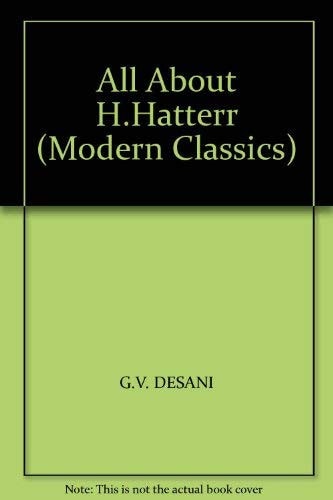
All About H. Hatterr (1948) is a classic novel by G. V. Desani chronicling the adventures of an Anglo-Malay man in search of wisdom and enlightenment. "As far back as in 1951," Desani later wrote, "I said H. Hatterr was a portrait of a man, the common vulgar species, found everywhere, both in the East and in the West". Salman Rushdie comments: “ The writer I have placed alongside Narayan, G.V. Desani, has fallen so far from favour that the extraordinary All About H. Hatterr is presently out of print everywhere, even in India. Milan Kundera once said that all modern literature descends from either Richardson's Clarissa or Sterne's Tristram Shandy, and if Narayan is India's Richardson then Desani is his Shandean other. Hatterr's dazzling, puzzling, leaping prose is the first genuine effort to go beyond the Englishness of the English language. His central figure, 'fifty-fifty of the species,' the half-breed as unabashed anti-hero, leaps and capers behind many of the texts in this book. Hard to imagine I. Allan Sealy's Trotter-Nama without Desani. My own writing, too, learned a trick or two from him.
Menrva's Summary
THE PULSE
H. Hatterr, a man of mixed heritage, navigates the complexities of colonial and post-colonial India in a quest for spiritual and worldly wisdom. Driven by a desire to understand the human condition, Hatterr encounters a series of 'sages' and eccentric figures who offer conflicting advice on life, morality, and existence. The narrative is framed through Hatterr's own idiosyncratic voice, which blends high-flown philosophical jargon with colloquialisms and inventive linguistic structures. He faces constant social and logical obstacles as he attempts to reconcile his identity as a 'fifty-fifty' man within a world defined by rigid cultural expectations.
INSIDE THE PAGES
- First-person narrative perspective from the protagonist
- Non-linear, episodic structure detailing various encounters
- Experimental use of English syntax and vocabulary
- Satirical treatment of colonial social hierarchies
- Philosophical inquiries presented through comedic situations
- Integration of diverse cultural and linguistic influences
- Use of an anti-hero archetype to challenge traditional literary tropes
- Meta-fictional commentary on the nature of storytelling
THE COLLECTIVE ECHO
Discussion often centers on the novel's linguistic innovation, which critics frequently compare to the works of Laurence Sterne for its playfulness and structural unpredictability. Readers highlight the protagonist's unique voice as a primary draw, noting how it effectively deconstructs the traditional English novel form. Many scholars emphasize the text's significance in the development of postcolonial literature, specifically regarding how it reclaims and reshapes the English language. The pacing is described as erratic and dense, reflecting the chaotic nature of the protagonist's search for enlightenment. Overall, the work is recognized for its intellectual ambition and its role as a precursor to later experimental fiction by authors like Salman Rushdie.
Page Count:
320
Publication Date:
1982-01-01
Publisher:
Penguin Books
ISBN-10:
0140061827
ISBN-13:
9780140061826
Fiction
Satire
Experimental
Humorous fiction
Indian
Postcolonial
Contemporary
Community Tags
Similar Books