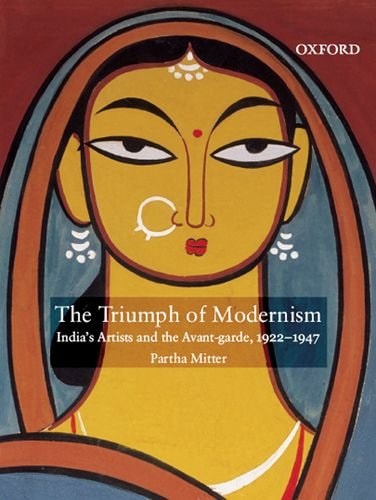
The Triumph of Modernism: India's Artists and the Avant-Garde, 1922-1947
0
0
As an Amazon Associate and affiliate partner, Menrva Books earns from qualifying purchases. Learn more
Author Description
The tumultuous last decades of British colonialism in India were catalyzed by more than the work of Mahatma Gandhi and violent conflicts. The concurrent upheavals in Western art driven by the advent of modernism provided Indian artists in post-1920 India a powerful tool of colonial resistance. Distinguished art historian Partha Mitter now explores in this brilliantly illustrated study this lesser known facet of Indian art and history. Taking the 1922 Bauhaus exhibition in Calcutta as the debut of European modernism in India, "The Triumph of Modernism" probes the intricate interplay of Western modernism and Indian nationalism in the evolution of colonial-era Indian art. Mitter casts his gaze across a myriad of issues, including the emergence of a feminine voice in Indian art, the decline of "oriental art," and the rise of naturalism and modernism in the 1920s. Nationalist politics also played a large role, from the struggle of artists in reconciling Indian nationalism with imperial patronage of the arts to the relationship between primitivism and modernism in Indian art. An engagingly written study anchored by 150 lush reproductions, "The Triumph of Modernism" will be essential reading for scholars of art, British studies, and Indian history.
Menrva's Summary
THE THESIS
This study investigates how the introduction of Western modernism served as a mechanism for colonial resistance among Indian artists during the final decades of British rule. Partha Mitter, a distinguished art historian, utilizes a framework that connects aesthetic evolution with the broader political climate of the Indian independence movement. By analyzing the period between 1922 and 1947, Mitter argues that Indian artists navigated a complex tension between imperial patronage and the desire for a distinct national identity. The text synthesizes historical data with visual analysis to demonstrate how artistic innovation functioned as a form of cultural autonomy.
THE SCOPE MAP
What You Will Find
- Analysis of the 1922 Bauhaus exhibition in Calcutta as a catalyst for Indian modernism.
- Examination of the shift from traditional orientalist art styles to naturalism and avant-garde techniques.
- Discussion of the emergence of feminine perspectives within the Indian art scene.
- Exploration of the intersection between nationalist politics and the rejection of imperial artistic standards.
THE AUTHORITY PERSPECTIVE
Scholars and art historians frequently cite this work as a foundational text for understanding the intersection of global modernism and post-colonial identity. Readers often note the academic rigor and the extensive use of visual reproductions to support the author's historical arguments.
Page Count:
271
Publication Date:
2007-01-01
Publisher:
Oxford University Press
ISBN-10:
0195693361
ISBN-13:
9780195693362
History
Modernism
Art History
Indian History
Community Tags
Similar Books














