The Myth of the Shrinking State: Globalization and the State in India
0
0
As an Amazon Associate and affiliate partner, Menrva Books earns from qualifying purchases. Learn more
Author Description
About the Author Baldev Raj Nayar is Professor Emeritus of Political Science, McGill University, Canada Product Description This study investigates the nature of the impact of globalization on the Indian state. It takes as its point of departure the thesis, set out in the introductory essay, that globalization has resulted in the erosion of the economic and welfare roles of the state.According to the author, theshift to liberalization, the resurgence of the private sector, and the acceleration of growth rate paradoxically "empowered" and "enabled" the state. He argues that the examination of the quantitative data strongly points to the continued expansion of the economic and welfare roles of the state,rather than decline. Therefore, the retrenchment of the state does not have much merit. He emphasizes on the fundamental continuity in the key functions of the state. He concludes by saying that the state is lagging behind in the areas of internal security, education and health, and makessuggestions for institutional reforms.
Menrva's Summary
THE THESIS
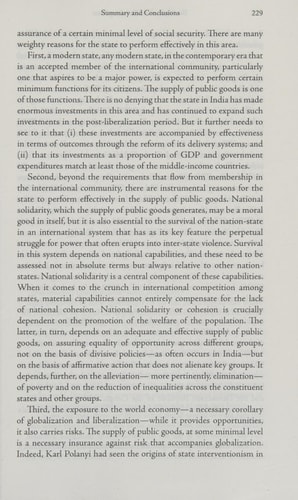
Does globalization inevitably lead to the erosion of the economic and welfare functions of the Indian state? Baldev Raj Nayar, Professor Emeritus of Political Science at McGill University, challenges the prevailing narrative that liberalization necessitates state retrenchment. By analyzing quantitative data regarding India's economic trajectory, Nayar argues that the state has actually been empowered and enabled by the shift toward private sector growth, maintaining fundamental continuity in its core responsibilities.
THE SCOPE MAP
What You Will Find
- Quantitative analysis of Indian economic and welfare policy trends post-liberalization.
- Evaluation of the state's role in internal security, education, and health sectors.
- Comparative assessment of state capacity versus private sector expansion.
- Proposed institutional reforms to address current administrative and service delivery gaps.
THE AUTHORITY PERSPECTIVE
Scholars in the field of South Asian political economy recognize this work as a critical counter-argument to the common assumption that globalization diminishes state power. Experts frequently cite the text for its rigorous use of data to challenge established theories regarding the Indian state's developmental role.
Page Count:
286
Publication Date:
2009-06-22
Publisher:
Oxford University Press
ISBN-10:
0195699394
ISBN-13:
9780195699395
Politics
Economics
Globalization
Categories
Kindle eBooks
India
Kindle Store
Words Language & Grammar
Public Policy
Reference
Linguistics
Community Tags
Similar Books