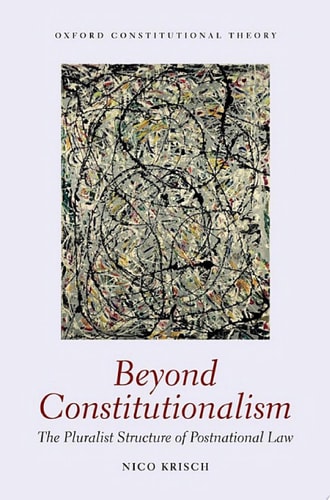
Beyond Constitutionalism: The Pluralist Structure of Postnational Law
0
0
As an Amazon Associate and affiliate partner, Menrva Books earns from qualifying purchases. Learn more
Author Description
Under pressure from globalisation, the classical distinction between domestic and international law has become increasingly blurred, spurring demand for new paradigms to construe the emerging postnational legal order. The typical response of constitutional and international lawyers as well as political theorists has been to extend domestic concepts - especially constitutionalism - beyond the state. Yet as this book argues, proposals for postnational constitutionalism not only fail to provide a plausible account of the changing shape of postnational law but also fall short as a normative vision. They either dilute constitutionalism's origins and appeal to 'fit' the postnational space; or they create tensions with the radical diversity of postnational society. This book explores an alternative, pluralist vision of postnational law. Pluralism does not rely on an overarching legal framework but is characterised by the heterarchical interaction of various suborders of different levels - an interaction that is governed by a multiplicity of conflict rules whose mutual relationship remains legally open. A pluralist model can account for the fragmented structure of the European and global legal orders and it reflects the competing (and often equally legitimate) claims for control of postnational politics. However, it typically provokes concerns about stability, power and the rule of law. This book analyses the promise and problems of pluralism through a theoretical enquiry and empirical research on major global governance regimes, including the European human rights regime, the contestation around UN sanctions and human rights, and the structure of global risk regulation. The empirical research reveals how prevalent pluralist structures are in postnational law and what advantages they possess over constitutionalist models. Despite the problems it also reveals, the analysis suggests cautious optimism about the possibility of stable and fair cooperation in pluralist settings.
Menrva's Summary
THE THESIS
This book investigates whether constitutionalism is an adequate framework for the emerging postnational legal order or if a pluralist model offers a more accurate and normative alternative. Nico Krisch, a scholar of international law and global governance, challenges the prevailing trend of extending domestic constitutional concepts to the international sphere. He argues that such attempts fail to account for the radical diversity of postnational society and proposes instead a heterarchical, pluralist structure that manages conflict without an overarching legal hierarchy.
THE SCOPE MAP
What You Will Find
- A theoretical framework for postnational legal pluralism
- Analysis of heterarchical interactions between suborders
- Empirical case studies on the European human rights regime, UN sanctions, and global risk regulation
Scope Limits
- The book does not provide a comprehensive manual for resolving all international legal disputes
- It does not offer a unified global constitution or a single centralized authority model
THE AUTHORITY PERSPECTIVE
Legal scholars and political theorists frequently cite this work as a significant contribution to the debate on global governance and the limits of constitutionalism. Experts often note the high level of academic density and the rigor with which the author balances theoretical inquiry with empirical observation.
Page Count:
383
Publication Date:
2010-01-01
Publisher:
OUP Oxford
ISBN-10:
0191637270
ISBN-13:
9780191637278
Kindle Store
Categories
Political Theory
Globalization
Legal Theory
Kindle eBooks
International Law
Law
Constitutional Law
Community Tags
Similar Books