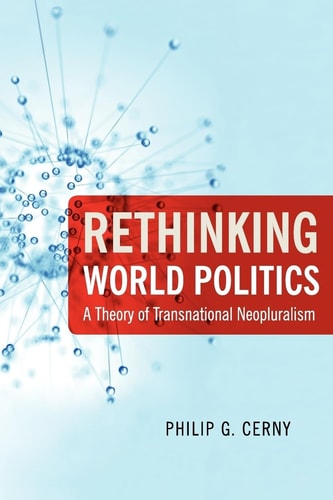
Rethinking World Politics: A Theory of Transnational Neopluralism
0
0
As an Amazon Associate and affiliate partner, Menrva Books earns from qualifying purchases. Learn more
Author Description
Rethinking World Politics is a major intervention into a central debate in international relations: how has globalization transformed world politics? Most work on world politics still presumes the following: in domestic affairs, individual states function as essentially unified entities, and in international affairs, stable nation-states interact with each other. In this scholarship, the state lies at the center; it is what politics is all about. However, Philip Cerny contends that recent experience suggests another process at work: "transnational neopluralism." In the old version of pluralist theory, the state is less a cohesive and unified entity than a varyingly stable amalgam of competing and cross-cutting interest groups that surround and populate it. Cerny explains that contemporary world politics is subject to similar pressures from a wide variety of sub- and supra-national actors, many of which are organized transnationally rather than nationally. In recent years, the ability of transnational governance bodies, NGOs, and transnational firms to shape world politics has steadily grown. Importantly, the rapidly growing transnational linkages among groups and the emergence of increasingly influential, even powerful, cross-border interest and value groups is new. These processes are not replacing nation-states, but they are forging new transnational webs of power. States, he argues, are themselves increasingly trapped in these webs. After mapping out the dynamics behind contemporary world politics, Cerny closes by prognosticating where this might all lead. Sweeping in its scope, Rethinking World Politics is a landmark work of international relations theory that upends much of our received wisdom about how world politics works and offers us new ways to think about the forces shaping the contemporary world.
Menrva's Summary
THE THESIS
This book investigates how the process of globalization has fundamentally altered the traditional state-centric model of international relations. Philip G. Cerny, a scholar of international political economy, utilizes a theoretical framework of "transnational neopluralism" to challenge the assumption that nation-states remain the primary, unified actors in global affairs. He argues that contemporary politics is increasingly defined by complex, cross-border webs of power involving sub-national and supra-national entities that constrain state autonomy.
THE SCOPE MAP
What You Will Find
- Analysis of the shift from state-centric models to transnational interest group dynamics.
- Theoretical framework of transnational neopluralism applied to global governance.
- Examination of the influence exerted by NGOs, transnational firms, and international bodies.
- Prognostications regarding the future trajectory of state power within globalized networks.
THE AUTHORITY PERSPECTIVE
Scholars and students of international relations frequently cite this work as a significant challenge to traditional realist and liberal paradigms. The text is noted for its high level of theoretical density and its rigorous attempt to redefine the structural mechanics of modern global politics.
Page Count:
352
Publication Date:
2010-03-24
Publisher:
Oxford University Press
ISBN-10:
0199733708
ISBN-13:
9780199733705
History
Politics
Kindle Store
Political Theory
Globalization
World politics
International relations
Categories
Governance
Specific Topics
Kindle eBooks
Community Tags
Similar Books