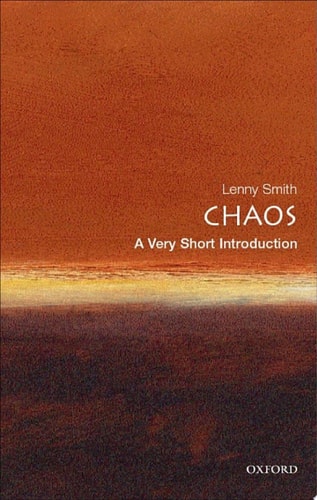
Oxford University Press Chaos: A Very Short Introduction
0
0
As an Amazon Associate and affiliate partner, Menrva Books earns from qualifying purchases. Learn more
Author Description
Chaos theory is a fascinating area of science that has captured the public imagination. It is often misunderstood as a synonym for randomness, but it is actually a study of complex systems that are highly sensitive to initial conditions. In this Very Short Introduction, Leonard Smith explores the history and development of chaos theory, and explains how it has changed our understanding of the world around us. He shows how chaos theory is used in a wide range of fields, from weather forecasting to economics, and discusses the limitations of our ability to predict the future.
Menrva's Summary
THE THESIS
This book investigates the fundamental nature of chaos theory and its implications for our understanding of predictability in complex systems. Leonard A. Smith, a professor of statistics and expert in nonlinear dynamics, utilizes his extensive background in atmospheric science and data analysis to demystify the concept of chaos. He argues that while chaos implies a lack of long-term predictability, it does not equate to randomness, providing a framework for how scientists model and interpret unpredictable phenomena in the real world.
THE SCOPE MAP
What You Will Find
- An explanation of the butterfly effect and sensitive dependence on initial conditions.
- Methodologies for distinguishing between deterministic chaos and stochastic noise.
- Case studies ranging from weather forecasting to economic modeling.
- Analysis of the limitations of mathematical models in predicting complex physical systems.
THE AUTHORITY PERSPECTIVE
Experts and educators frequently cite this work as a concise, high-level entry point for students and laypeople interested in nonlinear dynamics. Readers often note the clarity of the prose, which manages to distill complex mathematical concepts into accessible language without sacrificing technical accuracy.
Page Count:
0
Publication Date:
2007-01-01
Publisher:
Oxford University Press
ISBN-10:
0195692136
ISBN-13:
9780195692136
Science
Chaos Theory
Mathematics
Physics
Community Tags
Similar Books