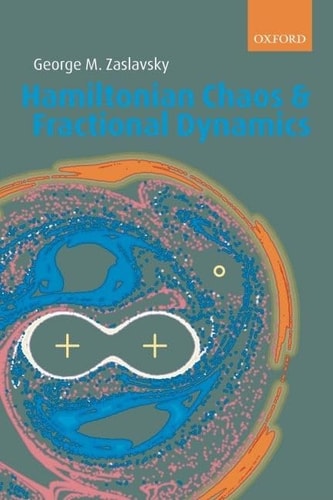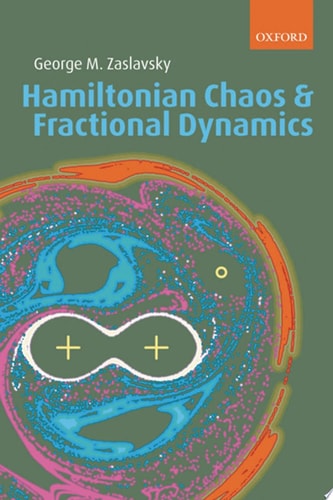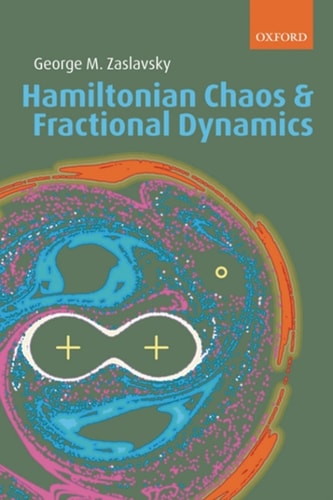
Hamiltonian Chaos and Fractional Dynamics
0
0
As an Amazon Associate and affiliate partner, Menrva Books earns from qualifying purchases. Learn more
Author Description
The dynamics of realistic Hamiltonian systems has unusual microscopic features that are direct consequences of its fractional space-time structure and its phase space topology. The book deals with the fractality of the chaotic dynamics and kinetics, and also includes material on non-ergodic and non-well-mixing Hamiltonian dynamics. The book does not follow the traditional scheme of most of today's literature on chaos. The intention of the author has been to put together some of the most complex and yet open problems on the general theory of chaotic systems. The importance of the discussed issues and an understanding of their origin should inspire students and researchers to touch upon some of the deepest aspects of nonlinear dynamics. The book considers the basic principles of the Hamiltonian theory of chaos and some applications including for example, the cooling of particles and signals, control and erasing of chaos, polynomial complexity, Maxwell's Demon, and others. It presents a new and realistic image of the origin of dynamical chaos and randomness. An understanding of the origin of randomness in dynamical systems, which cannot be of the same origin as chaos, provides new insights in the diverse fields of physics, biology, chemistry, and engineering.
Menrva's Summary
THE THESIS
This text investigates the microscopic features of Hamiltonian systems by analyzing their fractional space-time structure and phase space topology. George M. Zaslavsky, a recognized expert in nonlinear dynamics, synthesizes complex theoretical problems to challenge traditional interpretations of chaotic systems. The work argues that randomness in dynamical systems arises from distinct origins compared to standard chaos, providing a framework for understanding non-ergodic and non-well-mixing dynamics.
THE SCOPE MAP
What You Will Find
- Analysis of fractality in chaotic dynamics and kinetics
- Theoretical exploration of non-ergodic and non-well-mixing Hamiltonian systems
- Applications including particle cooling, signal control, and Maxwell's Demon
- Examination of polynomial complexity in dynamical systems
Scope Limits
- The text does not follow traditional, introductory pedagogical schemes for chaos theory
- It focuses specifically on Hamiltonian systems rather than dissipative or general dynamical systems
THE AUTHORITY PERSPECTIVE
Researchers and advanced students identify this work as a specialized resource for those seeking to understand the deeper, non-traditional aspects of nonlinear dynamics. The prose is noted for its high academic density and focus on complex theoretical problems rather than standard textbook derivations.
Page Count:
432
Publication Date:
2004-01-01
Publisher:
OUP Oxford
ISBN-10:
0191523518
ISBN-13:
9780191523519
Chaotic behavior in systems
Nonlinear Dynamics
Mathematics - General
Mathematics
Mathematics Statistics
Scientific Research
Chaos Theory
Physics