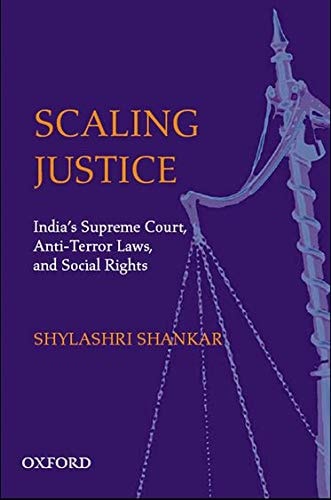
Scaling Justice: India's Supreme Court, Social Rights, and Civil Liberties
0
0
As an Amazon Associate and affiliate partner, Menrva Books earns from qualifying purchases. Learn more
Author Description
Product Description This book seeks to answer the question 'What influences the choices and decisions that Indian Supreme Court judges make?'. In different contexts and cases contradictory images remain in circulation; judges are variously described as passive, pro-active, impartial, biased, pro-citizen,pro-business, apolitical, pro-poor etc. After briefly explaining the views in different schools of thought, the author sets out her 'embedded negotiator' approach, which addresses the diverse influences on judicial decision- makers. In this approach the focus is trained on judges and their constantnegotiations within grey zones in the fields of civil liberties and social rights. To establish the validity of the approach the author uses the Probit model, which she also explains extensively. She studies a sample of civil liberties cases spanning the period 1950 to 2005 and social rights casespost Emergency. She collates the data base of cases with another data base containing characteristics of 116 Supreme Court judges, including religious affiliation. This is the first time that such a model has been used in Indian legal research. About the Author Shylashri Shankar is Fellow, Centre for Policy Research, New Delhi. She was awarded a PhD in Political Science by Columbia University, New York (May 2002)
Menrva's Summary
THE THESIS
This book investigates the primary factors that influence the judicial decision-making processes of the Indian Supreme Court regarding civil liberties and social rights. Shylashri Shankar, a Fellow at the Centre for Policy Research with a PhD from Columbia University, challenges existing perceptions of judicial behavior by introducing the 'embedded negotiator' framework. This approach posits that judges operate within complex grey zones, constantly balancing competing institutional and personal pressures. To support this, she employs the Probit model to analyze a comprehensive dataset of judicial rulings and judge characteristics spanning over five decades.
THE SCOPE MAP
What You Will Find
- A quantitative analysis of Supreme Court rulings on civil liberties from 1950 to 2005.
- An examination of social rights litigation in the post-Emergency era of Indian history.
- The application of the Probit statistical model to legal research within the Indian judiciary.
- A comparative dataset detailing the professional and personal characteristics of 116 Supreme Court judges.
THE AUTHORITY PERSPECTIVE
Experts recognize this work as a pioneering application of quantitative methodology to the study of the Indian legal system. Readers frequently note the academic density of the prose, which serves as a foundational text for those interested in the intersection of law, politics, and judicial behavior in South Asia.
Page Count:
230
Publication Date:
2012-11-09
Publisher:
Oxford University Press
ISBN-10:
0195693205
ISBN-13:
9780195693201
Human rights
Law
Terrorism
Courts_india
India
Community Tags
Similar Books