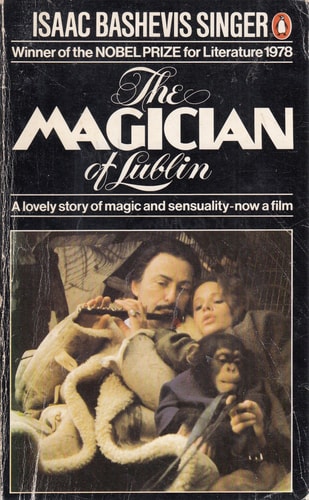
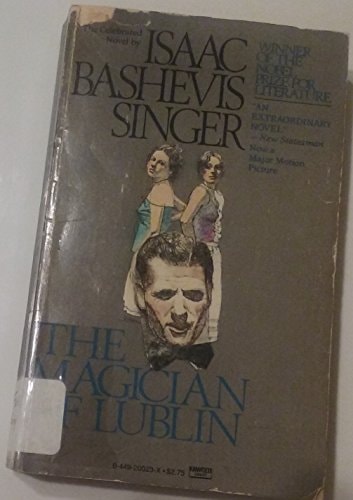
The Magician of Lublin
0
0
As an Amazon Associate and affiliate partner, Menrva Books earns from qualifying purchases. Learn more
Author Description
The fiftieth anniversary of a lost classic—a deceptively sophisticated tale of sexual compulsion and one man’s flight from loveYasha Mazur is a Houdini-like performer whose skill has made him famous throughout eastern Poland. Half Jewish, half Gentile, a freethinker who slips easily between worlds, Yasha has an observant Jewish wife, a Gentile assistant who travels with him, and a mistress in every town. For Yasha is an escape artist not only onstage but in life, a man who lives under the spell of his own hypnotic effect on women. Now, though, his exploits are catching up with him, and he is tempted to make one final escape—from his wife and his homeland and the last tendrils of his father’s religion.Set in Warsaw and the shtetls of the 1870s—but first published in 1960—Isaac Bashevis Singer’s second novel hides a haunting psychological portrait inside a beguiling parable. At its heart, this is a book about the burden of sexual freedom. As such, it belongs on a small shelf with such mid-century classics as Rabbit, Run; The Adventures of Augie March; and The Moviegoer. As Milton Hindus wrote in The New York Times Book Review, “The pathos of the ending may move the reader to tears, but they are not sentimental tears... [Singer] is a writer of far greater than ordinary powers.”
Menrva's Summary
THE PULSE
Yasha Mazur, a renowned escape artist, finds his carefully constructed life of deception unraveling as his personal compulsions collide with the rigid expectations of his society.
Yasha navigates the landscape of 1870s Poland, utilizing his skills as a magician to maintain a precarious balance between his Jewish heritage and his secular desires. He manages multiple relationships across different social spheres, yet his internal restlessness drives him toward a final, desperate act of liberation. The narrative follows his attempts to reconcile his identity as a performer with the moral consequences of his actions. The prose maintains a focus on the psychological tension inherent in his double life, utilizing a third-person perspective to observe his descent into isolation.
INSIDE THE PAGES
- Exploration of the conflict between religious tradition and secular modernity
- Detailed depiction of 19th-century Polish shtetl life and urban Warsaw
- Use of the escape artist motif as a metaphor for personal moral evasion
- Examination of sexual compulsion and its impact on interpersonal relationships
- Integration of Yiddish cultural elements and folklore sensibilities
- Focus on the internal monologue of a man attempting to reinvent his identity
- Pacing that mirrors the protagonist's increasing desperation and loss of control
- Symbolic use of magic and performance to represent the protagonist's detachment from reality
THE COLLECTIVE ECHO
Discussion often centers on the moral ambiguity of Yasha Mazur and the author's ability to render a complex psychological portrait within a historical setting. Readers frequently highlight the stark contrast between the protagonist's public charisma and his private emptiness. Critics often note the narrative's effectiveness in balancing the atmosphere of 19th-century Poland with universal themes of guilt and redemption. The work is widely regarded for its precise prose and its refusal to offer simple resolutions to the protagonist's existential crisis. Many readers appreciate how the story functions as both a character study and a broader commentary on the burden of individual freedom.
Page Count:
208
Publication Date:
1979-01-01
Publisher:
Penguin Books Ltd
ISBN-10:
0140048073
ISBN-13:
9780140048070
Fiction
Romance
Historical Fiction
History
Art
Literary Fiction
classic
Jewish Literature
Psychological
Community Tags
Other Editions(9)



Similar Books











Reader Comments
Share Your Thoughts
No comments yet. Be the first to share your thoughts!