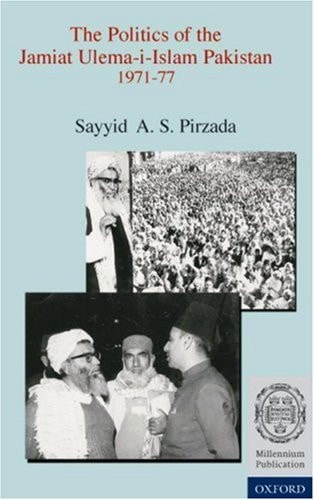
The Politics of the Jamiat Ulema-i-Islam Pakistan 1971-1977
0
0
As an Amazon Associate and affiliate partner, Menrva Books earns from qualifying purchases. Learn more
Author Description
The ulema claim that they stand for an Islamic system of government based on the pattern of the caliphate. This book attempts to analyze this claim by comparing the performance of the religious parties, particularly the JUI with socialist, and centrist parties in national politics.
Menrva's Summary
THE THESIS
This book investigates the political efficacy and ideological consistency of the Jamiat Ulema-i-Islam (JUI) in Pakistan during the formative years of 1971 to 1977. Sayyid A. S. Pirzada utilizes historical records and political analysis to evaluate the party's claim of advocating for a governance model rooted in the caliphate. By contrasting the JUI's legislative and social performance against the platforms of socialist and centrist political entities, the author provides a framework for understanding the intersection of religious doctrine and national policy in a developing state.
THE SCOPE MAP
What You Will Find
- A detailed examination of the Jamiat Ulema-i-Islam party platform and its evolution between 1971 and 1977.
- Comparative analysis of religious, socialist, and centrist political party performance in Pakistan.
- Primary source research regarding the implementation of Islamic governance claims.
- Contextual data on the political climate of Pakistan during the post-1971 era.
THE AUTHORITY PERSPECTIVE
Experts recognize this work as a specialized study of religious political movements in South Asia. Readers frequently note the academic density of the prose and the author's rigorous reliance on historical documentation to support his comparative analysis.
Page Count:
352
Publication Date:
2000-10-26
Publisher:
Oxford University Press, USA
ISBN-10:
0195793021
ISBN-13:
9780195793024
Religion
History
Pakistan
Islam
Islam And State
Islam And Politics
Community Tags
Similar Books