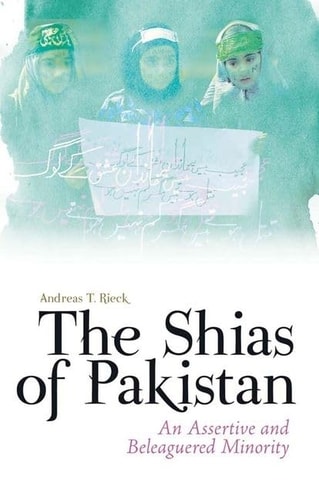
The Shias of Pakistan: An Assertive and Beleaguered Minority
0
0
As an Amazon Associate and affiliate partner, Menrva Books earns from qualifying purchases. Learn more
Author Description
The Shias of Pakistan are the world's second largest Shia community after that of Iran, but comprise only 10-15 per cent of Pakistan's population. In recent decades Sunni extremists have increasingly targeted them with hate propaganda and terrorism, yet paradoxically Shias have always been fully integrated into all sections of political, professional and social life without suffering any discrimination. In mainstream politics, the Shia- Sunni divide has never been an issue in Pakistan.Shia politicians in Pakistan have usually downplayed their religious beliefs, but there have always been individuals and groups who emphasised their Shia identity, and who zealously campaigned for equal rights for the Shias wherever and whenever they perceived these to be threatened. Shia 'ulama' have been at the forefront of communal activism in Pakistan since 1949, but Shia laymen also participated in such organisations, as they had in pre-partition India.Based mainly on Urdu sources, Rieck's book examines, first, the history of Pakistan's Shias, including their communal organisations, the growth of the Shia 'ulama' class, of religious schools and rivalry between "orthodox" "ulama" and popular preachers; second, the outcome of lobbying of successive Pakistan governments by Shia organisations; and third, the Shia-Sunni conflict, which is increasingly virulent due to the state's failure to combat Sunni extremism.
Menrva's Summary
THE THESIS
This work investigates the paradoxical status of the Shia community in Pakistan, balancing their deep integration into national life against the rising tide of sectarian violence and extremist targeting. Andreas Rieck, a scholar with extensive expertise in regional politics, utilizes a wealth of primary Urdu-language sources to construct a comprehensive historical and sociological framework. He argues that while Shia political identity has historically been downplayed to maintain national cohesion, the failure of the state to curb Sunni extremism has forced a shift toward more assertive communal activism.
THE SCOPE MAP
What You Will Find
- Historical analysis of Shia communal organizations from 1949 to the present.
- Examination of the internal dynamics within the Shia 'ulama' class and religious schools.
- Assessment of lobbying efforts directed at successive Pakistani governments.
- Detailed documentation of the escalation of sectarian conflict.
Scope Limits
- The text does not provide a comprehensive theological comparison between Shia and Sunni doctrines.
- It does not offer a predictive model for future sectarian stability in the region.
THE AUTHORITY PERSPECTIVE
Scholars and regional analysts frequently cite this work as a foundational text for understanding the complexities of sectarian identity in Pakistan. Readers often note the academic density of the prose and the author's meticulous reliance on primary Urdu sources to provide an objective account of a sensitive subject.
Page Count:
564
Publication Date:
2019-04-01
Publisher:
Oxford University Press
ISBN-10:
0190051906
ISBN-13:
9780190051907
Religion
Politics
History
Shiites
Asia
New Used & Rental Textbooks
Middle Eastern
Asian History
Sociology
Islam
Asia religion
Politics & Government
Pakistan
World politics
Shiism
India
Community Tags
Similar Books