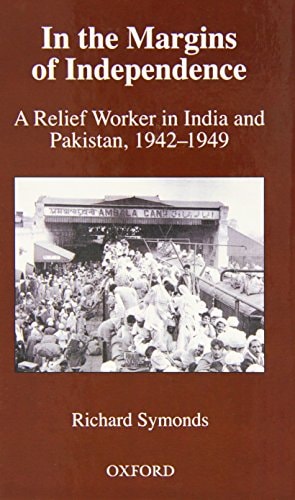
In the Margins of Independence: A Relief Worker in India and Pakistan, 1942-1949
0
0
As an Amazon Associate and affiliate partner, Menrva Books earns from qualifying purchases. Learn more
Author Description
This book presents a vivid, personal and authentic account of three cataclysmic events in the recent history of India and Pakistan. The first was the catastrophic Bengal famine of 1943, during which three million men, women and children died in British India. The second, the decision of the British to divide and quit in 1947, leading to the Partition of the Subcontinent and the accompanying turmoil, mass migrations, and massacre of at least 200,000 people, with twelve million rendered homeless. The third, the beginning of the conflict between India and Pakistan over the Kashmir issue, today's tinderbox'. Richard Symonds served in India with the Friends (Quaker) Ambulance Unit and then as a co-ordinator of relief and rehabilitation in the government of Bengal, during the Bengal famine. Later, immediately after independence, he worked in the West and East Punjab under Quaker auspices, reporting to the two governments on the situation of the minorities and helping the refugees. This work was extended into Kashmir. After his involvement in relief work he served on the staff of the UN Commission for India and Pakistan, whose activities led to the cease-fire in Kashmir in 1949. His recollections, eyewitness reports and first-hand insights of the events mentioned above are primarily in his diaries. The author's impressions of leading personalities such as Mahatma Gandhi, who took him into Birla House to be nursed when he fell ill during his refugee work, prove fascinating reading for the general as much as for the academic reader.
Menrva's Summary
THE THESIS
This work examines the humanitarian crises and political instability surrounding the independence and partition of India and Pakistan through the lens of an active relief worker. Richard Symonds, a member of the Friends Ambulance Unit, utilizes his personal diaries and eyewitness accounts to document the Bengal famine of 1943, the mass migrations of 1947, and the early stages of the Kashmir conflict. His narrative provides a ground-level perspective on the administrative and social failures that defined this period of transition in the subcontinent.
THE SCOPE MAP
What You Will Find
- Detailed eyewitness accounts of the 1943 Bengal famine and its immediate aftermath.
- First-hand observations of the mass displacement and violence following the 1947 Partition.
- Analysis of the early diplomatic efforts and relief operations in Kashmir.
- Personal reflections on interactions with historical figures including Mahatma Gandhi.
THE AUTHORITY PERSPECTIVE
Historians and scholars value this text as a primary source document that bridges the gap between high-level political history and the lived reality of humanitarian intervention. Readers frequently note the clarity of the author's prose and the unique perspective provided by his dual role as a relief worker and a UN staff member.
Page Count:
150
Publication Date:
2001-01-01
Publisher:
Oxford University Press
ISBN-10:
0195794400
ISBN-13:
9780195794403
Memoir
History
Biography
Pakistan
Asia
Community Tags
Similar Books