A Confederacy of Dunces
0
0
As an Amazon Associate and affiliate partner, Menrva Books earns from qualifying purchases. Learn more
Author Description
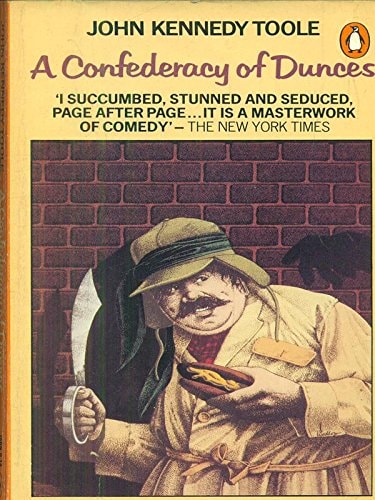
Here is Ignatius slob extraordinary, a mad Oliver Hardy, a fat Don Quixote, a perverse Thomas Aquinas rolled into one, who is in violent revolt against the entire modern age, lying in his flannel nightshirt in a back bedroom on Constantinople Street in New Orleans, who between gigantic seizures of flatulence and eructations is filling dozens of Big Chief tablets with invective.His mother thinks he needs to go to work. He does, in a succession of jobs. Each job rapidly escalates into a lunatic adventure, a full-blown disaster; yet each has, like Don Quixote's, its own eerie logic.His girlfriend, Myrna Minkoff of the Bronx, thinks he needs sex.Ignatius is an intellectual, ideologue, deadbeat, goof-off, glutton, who should repel the reader with his gargantuan bloats, his thunderous contempt, and one-man war against Freud, homosexuals, heterosexuals, Protestants, and the assorted excesses of modern times.A tragicomedy, set in New Orleans.
Menrva's Summary
THE PULSE
Ignatius J. Reilly, a self-styled philosopher and misanthrope, finds his comfortable existence in New Orleans disrupted when his mother forces him to seek employment. Ignatius navigates a series of absurd professional failures, each escalating into chaos as he attempts to impose his rigid, medieval worldview upon the modern world. Opposed by his mother, his persistent girlfriend Myrna Minkoff, and the general incompetence of the working class, Ignatius remains trapped by his own intellectual arrogance and physical inertia. The narrative utilizes a third-person perspective to document his descent into various social environments, highlighting the friction between his grandiose delusions and the mundane reality of 1960s New Orleans.
INSIDE THE PAGES
- Picaresque narrative structure following a series of episodic misadventures
- Vivid, atmospheric depiction of New Orleans street culture
- Use of idiosyncratic, archaic, and highly formal dialogue for the protagonist
- Satirical exploration of mid-century social and political ideologies
- Character-driven humor centered on the protagonist's extreme personality
- Integration of epistolary elements through Ignatius's Big Chief tablets
- Exploration of themes regarding intellectual isolation and societal non-conformity
- Contrast between high-minded philosophical rhetoric and base physical comedy
THE COLLECTIVE ECHO
Readers frequently highlight the singular voice of Ignatius J. Reilly as the primary draw of the work, noting his ability to be simultaneously repulsive and compelling. Discussion often centers on the author's precise command of dialect and the meticulous construction of the New Orleans setting. Critics observe that the pacing relies heavily on the escalating absurdity of the protagonist's interactions with a colorful supporting cast. The balance between slapstick physical comedy and dense philosophical critique remains a frequent point of analysis for those examining the book's enduring status. Many readers find the work's cynical humor to be a sharp commentary on the disconnect between intellectual theory and practical living.
Page Count:
352
Publication Date:
1981-01-01
Publisher:
Grove Press
ISBN-10:
014005930X
ISBN-13:
9780140059304
Humor
Satire
classic
Literary
Picaresque
Southern Gothic