M12 Gun Motor Carriage
0
0
As an Amazon Associate and affiliate partner, Menrva Books earns from qualifying purchases. Learn more
Author Description
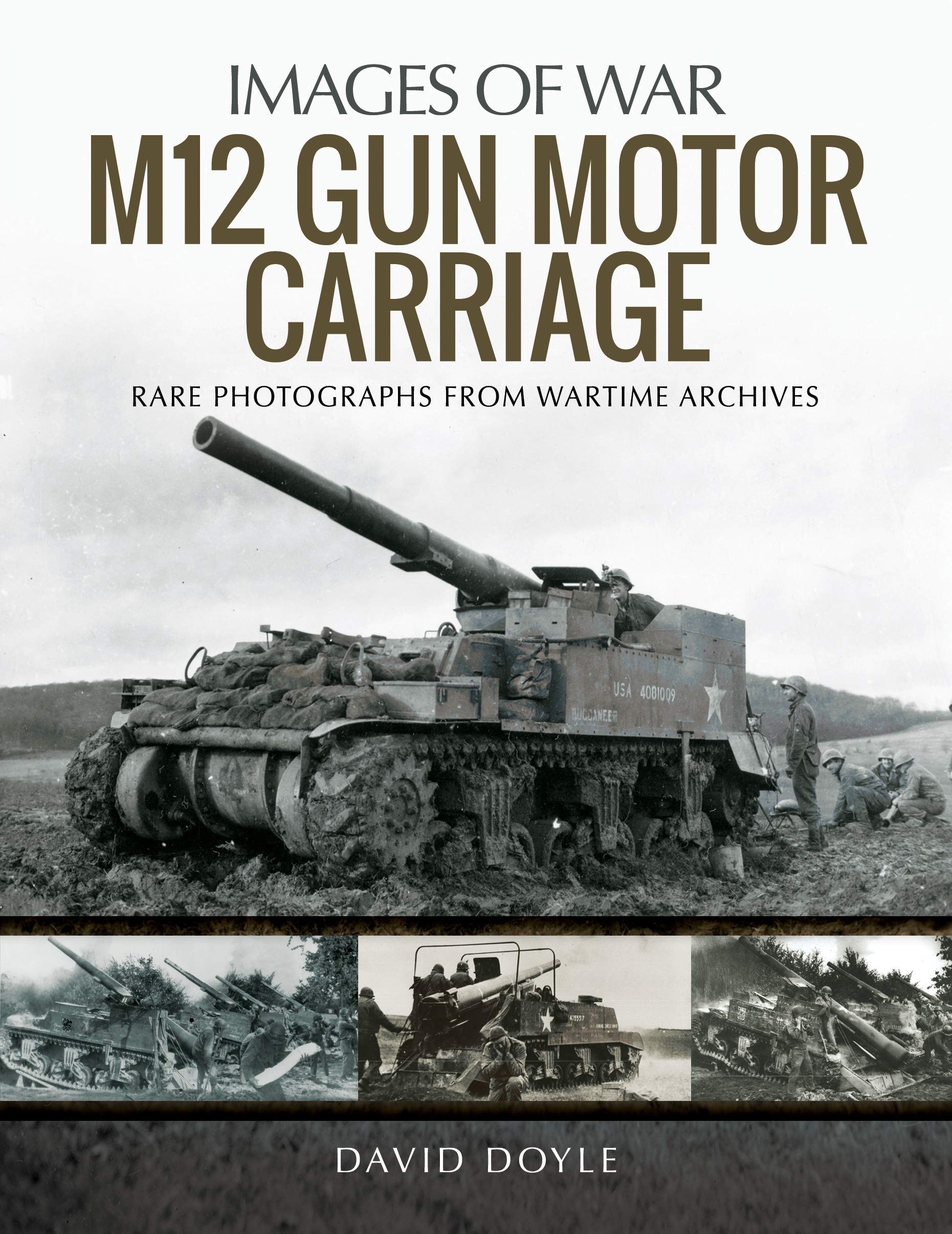
Although only 100 examples were produced, the 155mm Gun Motor Carriage M12 served with distinction as an infantry-support weapon and in particular as a bunker-buster during the U.S. assault on the Siegfried Line in the winter of 1944-45. The ability to rapidly ready heavy artillery for firing lead to the development of the M12 155mm gun in 1941, based on the M3 Medium Tank chassis. The trial vehicle, built by Rock Island Arsenal, was designated T6. To accommodate the large, rear mounted weapon - a French-made M1917 155mm gun, the engine was relocated forward to a position just behind the driving compartment. A hydraulically operated spade mounted at the rear of the vehicle, which was lowered during firing to anchor the vehicle against the recoil. When retracted into the travelling position it provided a seat for two of the six crewmen. The production run was between September 1942 and March 1943, with a total of one hundred units being built. Though a few were used by training units, most were placed in storage until February 1944, when the first of 74 of them were shipped to Baldwin Locomotive Works to be improved based on further tests and usage in training. This work continued until May 1944. Three slightly different WWI surplus weapons were mounted depending upon availability, the M1917, the M1917A1 and the M1918M1. The M1917 was French built, the M1918 was US built, and the M1917A1 had the French gun tube, and the US breech. The M12 would earn the nickname "Door Knocker" for its pounding of the German Siegfried Line.
Menrva's Summary
THE THESIS
This book investigates the development, production, and combat deployment of the M12 155mm Gun Motor Carriage, a specialized armored artillery piece that played a significant role in specific World War II campaigns. Authored by David P. Doyle, a historian specializing in military vehicles, this work draws upon technical specifications, production records, and combat reports to detail the M12's lineage. Based on the M3 Medium Tank chassis, the M12 was designed to rapidly deploy heavy artillery, particularly for infantry support and bunker destruction, as evidenced by its crucial role in the assault on the Siegfried Line. The book examines the modifications made to the chassis to accommodate the large French-made M1917 155mm gun, including the relocation of the engine and the addition of a rear-mounted spade for recoil stabilization.
THE SCOPE MAP
- Detailed examination of the M12 155mm Gun Motor Carriage's design and engineering.
- Analysis of the production history, including the Rock Island Arsenal's role and the limited run of 100 units.
- Description of the specific weaponry employed, including variations of the M1917 155mm gun.
- Account of the M12's combat service, particularly its effectiveness as a bunker-buster during the U.S. assault on the Siegfried Line and its nickname 'Door Knocker'.
THE AUTHORITY PERSPECTIVE
This book is likely to be regarded as a detailed technical and historical account of a specific World War II armored artillery piece. The author's focus on the M12's development, production, and combat use suggests a work aimed at military history enthusiasts and armor aficionados. The description highlights the vehicle's unique design features and its notable impact in specific combat scenarios, indicating a thorough exploration of its operational significance.
Page Count:
152
Publication Date:
2018-01-01
Publisher:
Pen & Sword Books Limited
ISBN-10:
1526743523
ISBN-13:
9781526743527
Non-Fiction
History
Vehicles
Military History
Community Tags
Similar Books