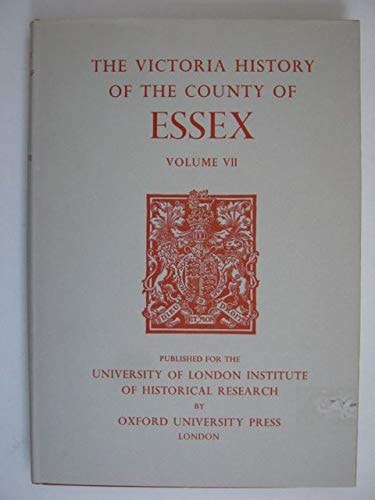
A History of the County of Essex: Volume VII
0
0
As an Amazon Associate and affiliate partner, Menrva Books earns from qualifying purchases. Learn more
Author Description
This volume covers the liberty of Havering-atte-Bower and part of Chafford hundred. The area coincides approximately with that of the London Borough of Havering, which was formed in 1965, stretching northward from the Thames. The liberty of Havering-atte-Bower, with its royal manor-house, usually formed part of the queen of England's dower from the 13th century to the 17th. Its tenants had special privileges and it had a measure of admini-strative independence which was formalized in a royal charter of 1465. The liberty included Hornchurch, whose priory build-ings are examined in the volume in a fresh light, and the chapelries of Romford and Havering-atte-Bower. While the last has remained largely rural, Hornchurch was an industrial village which has become a dormitory suburb and Romford was a market town which has become a shopping centre serving estates such as those at Gidea Park, which originated as a garden suburb, and Harold Hill. Chafford hundred, once largely agri-cultural with moated manor-houses and extensive marshland sheep-pastures, still has a few farms, but parishes like Upminster and Cranham have in the 20th century acquired large commuter suburbs. Along the Thames, where Rainham was once a small port for coastal shipping and an early, harbour at Wennington creek has been identified, there is an industrial area making ferro-alloys and providing storage for oil and petroleum. At Little Watley (which like South Ockendon is outside the London Borough of Havering but is included in the present volume) the head-quarters of the Ford Motor Co. Ltd. have replaced a military camp and the barracks of the Essex Regiment. Among the large houses that survive those treated in the volume include Bower House, Bretons, and Langtons, and accounts are also given of others that have been demolished. The gardens at Warley Park, now derelict, were once among the most notable in Europe.
Menrva's Summary
THE THESIS
This volume investigates the historical development, administrative evolution, and land-use patterns of the liberty of Havering-atte-Bower and the Chafford hundred in Essex. W. R. Powell, a noted contributor to the Victoria County History project, utilizes extensive archival research and topographical analysis to document the transition of these areas from rural manors and agricultural landscapes to modern suburban and industrial centers. The text provides a rigorous examination of how royal charters, economic shifts, and urban expansion shaped the specific parishes within this region over several centuries.
THE SCOPE MAP
What You Will Find
- Detailed administrative history of the liberty of Havering-atte-Bower and Chafford hundred.
- Analysis of land-use transitions from agricultural sheep-pastures to industrial and commuter suburbs.
- Examination of architectural heritage, including manor houses, priory buildings, and garden estates.
- Documentation of economic shifts along the Thames, including port history and modern industrial development.
THE AUTHORITY PERSPECTIVE
Experts and local historians regard this volume as a foundational reference for the study of Essex topography and administrative history. Readers frequently note the academic density of the prose, which serves as a comprehensive resource for researchers interested in the specific evolution of the London Borough of Havering and its surrounding parishes.
Page Count:
248
Publication Date:
1978-02-01
Publisher:
Victoria County History
ISBN-10:
0197227201
ISBN-13:
9780197227206
History
Great Britain
Local History
Reference
Geography
British History
Community Tags
Similar Books