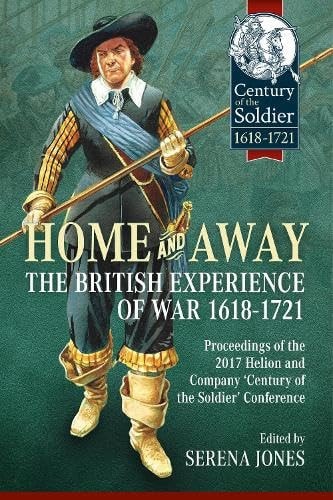
Home and Away: The British Experience of War 1618-1721
0
0
As an Amazon Associate and affiliate partner, Menrva Books earns from qualifying purchases. Learn more
Author Description
The experience of war is never confined to those who participate militarily: the consequences of warfare ripple out across their immediate families and communities, and the lives of countless civilians the combatants will never meet. The wives and children of soldiers could become destitute in the absence of their menfolk, and in the seventeenth century many sought refuge far from their homes or followed the army on its travels. Feeding and clothing an army, and supplying it with ammunition and other materiel, was a critical business; many women, and also many civilian men, provided services to the army baggage train and effectively became a critical part of its supply chain. The speakers at Helion''s third English Civil War conference focussed on a variety of aspects relating to both the personal experiences of warfare and the herculean efforts required to keep a conflict going. Keynote speaker Professor Peter Gaunt, focusing on the English Civil Wars of the 1640s, explores what is arguably the most gruelling and uncertain aspect of warfare, besides battle itself: the necessity of travel, often for great distances and to unfamiliar or even hostile places. Using case studies focusing on different parts of the country, Professor Gaunt draws upon surviving letters and printed or archival first person accounts to recount and analyse the experience of moving around during the wars, whether to pursue their objectives or to flee from their effects. The Lostwithiel campaign in Cornwall in 1644 took both King Charles''s and the Parliament''s armies on a lengthy trek to the furthest extent of England: Simon Marsh examines the disastrous consequences of the campaign on the Earl of Essex''s army, nearly destroyed as a fighting force, and yet how within two months it was able to recover and fight with distinction against the King''s forces at the Second Battle of Newbury. Mr Marsh also examines how effective the Parliamentarian supply system had become by 1644; logistics are cr
Menrva's Summary
THE THESIS
This collection of essays examines the multifaceted experience of war in Britain between 1618 and 1721, extending beyond the battlefield to encompass the profound impact on soldiers' families, communities, and the civilian populace. The book explores how warfare's consequences rippled outwards, affecting wives and children who faced destitution or followed armies, and highlighting the critical role of civilians in supplying and sustaining military operations. It draws on papers presented at the 2017 Helion and Company 'Century of the Soldier' Conference, focusing on both personal experiences and the logistical challenges of prolonged conflict.
THE SCOPE MAP
- Analysis of the personal experiences of soldiers and their families during periods of conflict.
- Exploration of the logistical and supply chain challenges inherent in maintaining armies.
- Case studies focusing on specific campaigns and their impact, such as the Lostwithiel campaign in Cornwall (1644).
- Examination of the role of women and civilian men in providing essential services to armies.
- Discussion of the necessity and difficulties of travel and movement for armies and civilians during wartime.
- Insights into the recovery and resilience of military forces following significant setbacks.
- Utilizes surviving letters, archival documents, and first-person accounts to reconstruct historical experiences.
THE AUTHORITY PERSPECTIVE
The collection is based on papers presented at a specialized conference, suggesting a scholarly and detailed approach to the subject matter. The focus on the 'British Experience of War 1618-1721' indicates a deep dive into a specific historical period and geographical context, likely appealing to historians and enthusiasts of military and social history. The inclusion of diverse aspects, from personal family impacts to logistical operations, suggests a comprehensive overview of how war permeated society. The contributions from academics like Professor Peter Gaunt and Simon Marsh point towards rigorous historical analysis grounded in primary sources.
Page Count:
216
Publication Date:
2025-08-01
Publisher:
Helion, Limited
ISBN-10:
180451845X
ISBN-13:
9781804518458
Non-Fiction
History
Warfare
Military History
Seventeenth Century
Social History
Community Tags
Similar Books