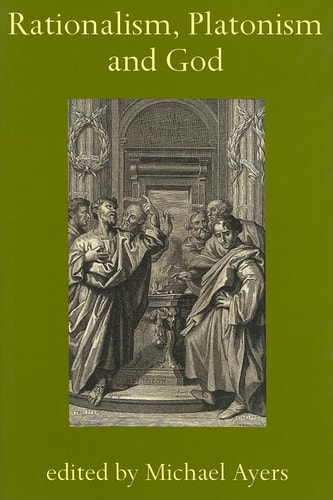
Rationalism, Platonism and God: A Symposium on Early Modern Philosophy
0
0
As an Amazon Associate and affiliate partner, Menrva Books earns from qualifying purchases. Learn more
Author Description
Rationalism, Platonism and God comprises three main papers on Descartes, Spinoza and Leibniz, with extensive responses. It provides a significant contribution to the exploration of the common ground of the great early-modern Rationalist theories, and an examination of the ways in which the mainstream Platonic tradition permeates these theories.John Cottingham identifies characteristically Platonic themes in Descartes's cosmology and metaphysics, finding them associated with two distinct, even opposed attitudes to nature and the human condition, one ancient and "contemplative", the other modern and "controlling". He finds the same tension in Descartes's moral theory, and believes that it remains unresolved in present-day ethics.Was Spinoza a Neoplatonist theist, critical Cartesian, or naturalistic materialist? Michael Ayers argues that he was all of these. Analysis of his system reveals how Spinoza employed Neoplatonist monism against Descartes's Platonist pluralism. Yet the terminology - like the physics - is Cartesian. And within this Platonic-Cartesian shell Spinoza developed a rigorously naturalistic metaphysics and even, Ayers claims, an effectually empiricist epistemology.Robert Merrihew Adams focuses on the Rationalists' arguments for the Platonist, anti-Empiricist principle of "the priority of the perfect", i.e. the principle that finite attributes are to be understood through corresponding perfections of God, rather than the reverse. He finds the given arguments unsatisfactory but stimulating, and offers a development of one of Leibniz's for consideration.These papers receive informed and constructive criticism and development at the hands of, respectively, Douglas Hedley, Sarah Hutton and Maria Rosa Antognazza.
Menrva's Summary
THE THESIS
This volume investigates the extent to which the Platonic tradition informs the metaphysical and cosmological frameworks of early modern Rationalist philosophers. Michael Ayers and his contributors examine the intersection of Cartesian, Spinozist, and Leibnizian thought with Neoplatonic concepts, specifically focusing on how these thinkers navigated the tension between ancient contemplative traditions and emerging modern scientific control. By analyzing the works of Descartes, Spinoza, and Leibniz, the authors provide a rigorous assessment of how these philosophers utilized, adapted, or rejected Platonic principles to construct their respective systems.
THE SCOPE MAP
What You Will Find
- Comparative analysis of Cartesian, Spinozist, and Leibnizian metaphysical systems.
- Examination of the principle of the priority of the perfect in anti-Empiricist arguments.
- Scholarly responses and critical developments from contemporary philosophers including Douglas Hedley and Maria Rosa Antognazza.
- Investigation into the influence of Neoplatonist monism versus Platonist pluralism in early modern thought.
THE AUTHORITY PERSPECTIVE
Experts identify this collection as a specialized resource for scholars of early modern philosophy, noting the high level of technical engagement with primary texts. The prose is dense and academic, serving as a focused contribution to the ongoing discourse regarding the historical roots of Rationalist theory.
Page Count:
160
Publication Date:
2008-04-15
Publisher:
British Academy
ISBN-10:
0197264204
ISBN-13:
9780197264201
Philosophy
Rationalism
God
Platonists
Epistemology
Metaphysics
Community Tags
Similar Books