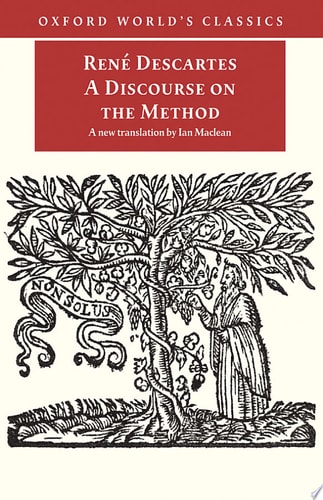
Discourse on the Method
0
0
As an Amazon Associate and affiliate partner, Menrva Books earns from qualifying purchases. Learn more
Author Description
'I concluded that I was a substance whose whole essence or nature resides only in thinking, and which, in order to exist, has no need of place and is not dependent on any material thing.' Descartes's A Discourse on the Method of Correctly Conducting One's Reason and Seeking Truth in the Sciences marks a watershed in European thought; in it, the author provides an informal intellectual autobiography in the vernacular for a non-specialist readership, sweeps away all previous philosophical traditions, and sets out in brief his radical new philosophy, which begins with a proof of the existence of the self (the famous 'cogito ergo sum'), next deduces from it the existence and nature of God, and ends by offering a radical new account of the physical world and of human and animal nature. This new translation is accompanied by a substantial introductory essay which draws on Descartes's correspondence to examine his motivation and the impact of his great work on his contemporaries. Detailed notes explain his philosophical terminology and ideas. About the series: For over 100 years Oxford World's Classics has made available the widest range of literature from around the globe. Each affordable volume reflects Oxford's commitment to scholarship, providing the most accurate text plus a wealth of other valuable features, including expert introductions by leading authorities, helpful notes to clarify the text, up-to-date bibliographies for further study, and much more.
Menrva's Summary
THE THESIS
How can an individual establish a foundation for certain knowledge by systematically doubting all previous beliefs? Rene Descartes, a foundational figure in modern Western philosophy, utilizes an autobiographical framework to dismantle scholastic traditions. He proposes a method of radical doubt to isolate the self as a thinking entity, subsequently building a logical structure to prove the existence of God and the nature of the physical world.
THE SCOPE MAP
What You Will Find
- The foundational argument of 'cogito ergo sum' as a starting point for rational inquiry
- A methodology for scientific and philosophical reasoning
- An analysis of human and animal nature within a mechanical framework
Scope Limits
- The text does not provide an exhaustive scientific treatise, but rather an introductory outline of his broader philosophical system
- It does not engage deeply with the specific theological counter-arguments of his era
THE AUTHORITY PERSPECTIVE
Scholars and students frequently identify this work as the essential starting point for understanding modern rationalist philosophy. Readers often note the accessibility of the prose compared to later, more technical philosophical texts, though they emphasize that the introductory essay and notes are necessary for navigating the historical context of Descartes's arguments.
Page Count:
160
Publication Date:
2006-01-01
Publisher:
Ebsco Publishing
ISBN-10:
0191517720
ISBN-13:
9780191517723
Philosophy
Non-Fiction
Rationalism
Metaphysics
Epistemology
Philosophy French
Classic Philosophy
Community Tags
Similar Books