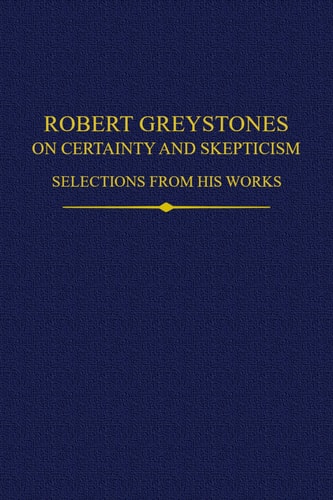
Robert Greystones on Certainty and Skepticism: Selections from His Works
0
0
As an Amazon Associate and affiliate partner, Menrva Books earns from qualifying purchases. Learn more
Author Description
Robert Greystones on Certainty and Skepticism: Selections from His Works is a continuation of the volume previously published by Auctores Britannici Medii Aevi, Robert Greystones on the Freedom of the Will: Selections from His Commentary on the Sentences (edited by Mark Henninger, with Robert Andrews and Jennifer Ottman, 2017). In the course of preparation of the first volume, startling information arose concerning the nature and extent of Greystones' skepticism. Following draft editions of a number of Greystones' Sentences commentary questions, the most relevant five questions were selected for editing and translation.Greystones is in the tradition of Nicholas of Autrecourt, William Crathorn, Monachus Niger (the Black Monk), Nicholas Aston, and John Went, but the earliest of these figures. Building upon the 69th proposition of the Condemnation of 1277, Greystones concludes that God's unlimited power must lead to a radical skepticism about human knowledge. We cannot be certain whether we are in this life or the afterlife, in a body or not. We cannot be certain about the existence of any external object. We have no certain knowledge of cause and effect, the existence of substances, or of any contingent event. Like Descartes, Greystones held that we can be certain about our own existence (ego sum). But preempting Descartes' appeal to a beneficent, non-deceptive God, Greystones says: God does not deceive. But you deceive yourself if you insist on believing that something exists when you know that it might not! You know that God can intervene at any instant, and thus that you can never completely trust your senses. Greystones' skepticism is strikingly significant in light of the later historical development of philosophy.Recent researchers on medieval skepticism such as Henrik Lagerlund, Dominik Perler, and Jos é Luis Bermúdez show no awareness of Greystones. Indeed, Bermúdez claims that "the resources were not available in the thirteenth and fourteenth centuries to ent
Menrva's Summary
THE THESIS
This volume investigates the extent and nature of Robert Greystones' radical skepticism regarding human knowledge and the limits of certainty in the medieval period. The editors, Jennifer Ottman, Mark G. Henninger, and Robert Andrews, utilize draft editions of Greystones' commentary on the Sentences to present five critical questions. By situating Greystones within the tradition of fourteenth-century thinkers like Nicholas of Autrecourt, the authors argue that his focus on divine power leads to a profound doubt concerning external objects, causality, and sensory perception.
THE SCOPE MAP
What You Will Find
- Critical editions and translations of five key questions from Greystones' commentary on the Sentences.
- A comparative analysis linking Greystones to other medieval skeptics such as William Crathorn and Nicholas Aston.
- Philosophical arguments regarding the 69th proposition of the Condemnation of 1277.
- A historical re-evaluation of the origins of skepticism, challenging modern claims that such resources were unavailable in the fourteenth century.
THE AUTHORITY PERSPECTIVE
Scholars in the field of medieval philosophy identify this work as a significant contribution to the study of pre-Cartesian skepticism. Readers frequently note the academic density of the prose and the importance of the text in correcting historical oversights regarding the development of epistemological thought.
Page Count:
587
Publication Date:
2020-01-01
Publisher:
Oxford University Press
ISBN-10:
0197266592
ISBN-13:
9780197266595
Philosophy
Epistemology
Academic
Theology doctrinal
Community Tags
Similar Books
Reader Comments
Share Your Thoughts
No comments yet. Be the first to share your thoughts!