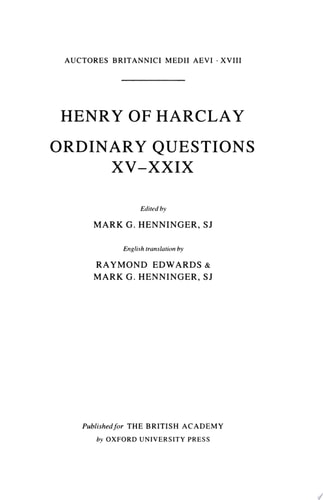
Henry of Harclay: Ordinary Questions, XV-XXIX
0
0
As an Amazon Associate and affiliate partner, Menrva Books earns from qualifying purchases. Learn more
Author Description
This volume completes the first full edition of the later work of the medieval philosopher and theologian Henry of Harclay. In collaboration with Raymond Edwards, an English translation is printed on facing pages, making this work available to a much wider audience.The twenty-nine Quaestiones Ordinariae cover a range of topics in metaphysics, theology, physical science, philosophical anthropology and ethics, which were among the most important of those debated in the early fourteenth century. The articles provide a window to this era, as Harclay discusses many of the main questions of his day: whether and why we choose what is evil, how God can know the future and we can still be free, what a virtue is, whether the human soul survives death, whether all things are made up of atoms.This edition enables us to evaluate Harclay, not only in relation to other notable thinkers of his time (such as John Duns Scotus and William of Ockham) but to appreciate the inner coherence of his own thought. An extensive introduction to Harclay's life, works and doctrine is provided. The volumes will also benefit scholars following the debates among lesser-studied thinkers such as William of Alnwick, Thomas of Sutton, Nicholas Trivet, and Robert Walsingham, whom this edition shows to have been in dialogue with Harclay during the years of the composition of his Quaestiones, 1310-1317.Because of the clarity of Harclay's thought and style, now mirrored in the English translation, the Quaestiones Ordinariae are an ideal way to introduce students to key problems in medieval philosophy, as well as to enable scholars to deepen their knowledge of the debates of this period.Questions 1-14, together with an extensive introduction, were published as volume XVII in the Auctores series.
Menrva's Summary
THE THESIS
This volume completes the critical edition and translation of Henry of Harclay's Quaestiones Ordinariae, investigating the core metaphysical, theological, and ethical debates of the early fourteenth century. Mark G. Henninger, a scholar specializing in medieval philosophy, provides a rigorous framework for understanding Harclay’s contributions to scholastic thought. By presenting the original Latin alongside a modern English translation, the work allows for a precise evaluation of Harclay’s intellectual coherence and his active engagement with contemporaries like Duns Scotus and William of Ockham.
THE SCOPE MAP
What You Will Find
- A comprehensive collection of questions XV through XXIX from Harclay's later works.
- Analysis of fourteenth-century debates regarding human free will, divine foreknowledge, and the nature of the soul.
- Scholarly examination of physical science topics, including the potential atomic composition of matter.
- Contextual documentation of the intellectual dialogue between Harclay and thinkers such as William of Alnwick and Nicholas Trivet.
THE AUTHORITY PERSPECTIVE
Scholars and historians of medieval philosophy identify this edition as a vital resource for accessing the complex scholastic debates of the 1310-1317 period. The inclusion of facing-page translations is frequently noted by academics as a significant improvement in accessibility for both students and researchers.
Page Count:
400
Publication Date:
2008-04-30
Publisher:
British Academy
ISBN-10:
019726381X
ISBN-13:
9780197263815
Philosophy
Theology
Ethics
Metaphysics
Academic
Community Tags
Similar Books