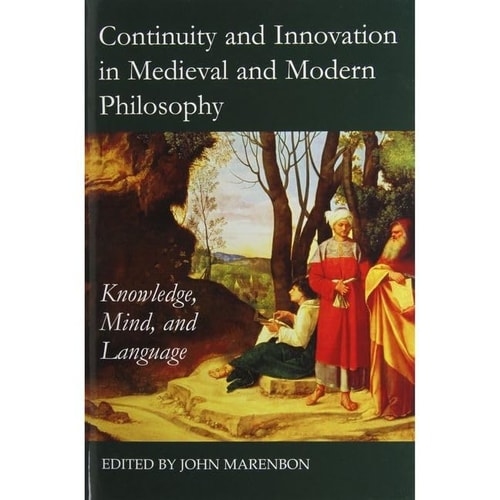
Continuity and Innovation in Medieval and Modern Philosophy: Knowledge, Mind and Language
0
0
As an Amazon Associate and affiliate partner, Menrva Books earns from qualifying purchases. Learn more
Author Description
The usual division of philosophy into "medieval" and "modern" may obscure very real continuities in the ideas of thinkers in the western and Islamic traditions. This book examines three areas where these continuities are particularly clear: knowledge, the mind, and language.Dominik Perler shows how, when Descartes attacked faculty psychology, he was indeed separating himself from one strand of the medieval tradition, represented by Suarez, but at the same time he was closely following another strand, found in Ockham.Martin Lenz shows how Locke's philosophy of language fits into a long medieval tradition of thought based on Aristotle's On Interpretation. Locke introduced the requirement that a word be linked to an idea in the speaker's mind, but Lenz argues that this does not mean that Locke was proposing that we each have a private language.Robert Pasnau looks at an area where the continuity between the attitudes of, for instance, Aquinas and Locke contrasts with views generally held in Islam and among Jewish thinkers. Whereas Latin thinkers rarely defended the idea that some knowledge should be kept for the elite, this view was held by al-Ghazali, Averroes and Maimonides - and it may, he argues, be a defensible philosophical position today.The chapters are based on papers given at a symposium at the British Academy and are presented here with responses by Andrew Pyle, Michael Ayers and John Hawthorne.
Menrva's Summary
THE THESIS
This volume investigates the historical and conceptual continuities between medieval and modern philosophical traditions, challenging the conventional binary division between these two eras. Edited by John Marenbon, the work compiles scholarly research that examines how thinkers in the Western, Islamic, and Jewish traditions navigated shared problems regarding knowledge, the mind, and language. By analyzing specific case studies from figures such as Descartes, Locke, Aquinas, and Averroes, the contributors demonstrate that modern philosophical developments often emerge from, rather than break with, medieval frameworks.
THE SCOPE MAP
What You Will Find
- Comparative analysis of faculty psychology and linguistic theory across the medieval and modern periods.
- Examination of the transmission and adaptation of Aristotelian thought in Western and Islamic contexts.
- Scholarly papers from a British Academy symposium supplemented by critical responses from contemporary experts.
- Investigations into the social and elitist dimensions of knowledge distribution in medieval religious and philosophical thought.
THE AUTHORITY PERSPECTIVE
Experts recognize this collection as a significant contribution to the historiography of philosophy, particularly for its nuanced approach to the transition between medieval and modern thought. Readers frequently note the academic density of the prose, which is intended for advanced students and professional philosophers familiar with the primary texts discussed.
Page Count:
150
Publication Date:
2013-07-24
Publisher:
British Academy
ISBN-10:
0197265499
ISBN-13:
9780197265499
Philosophy
Modern Philosophy
Philosophy Modern
Epistemology
Community Tags
Similar Books