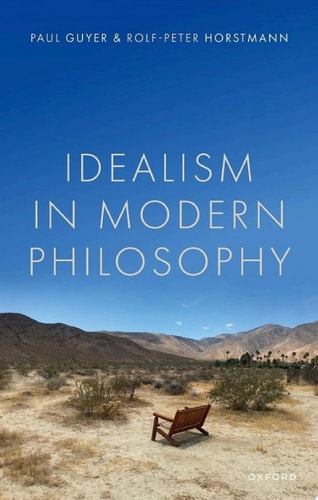
Idealism in Modern Philosophy
0
0
As an Amazon Associate and affiliate partner, Menrva Books earns from qualifying purchases. Learn more
Author Description
This book tells the story of idealism in modern philosophy, from the seventeenth century to the turn of the twenty-first. Paul Guyer and Rolf-Peter Horstmann define idealism as the reduction of all reality to something mental in nature. Rather than distinguishing between metaphysical and epistemological versions of idealism, they distinguish between metaphysical and epistemological motivations for idealism. They argue that while metaphysical arguments for idealism have only rarely been accepted, for example by Bishop Berkeley in the early eighteenth century and the British idealists Bradley and McTaggart in the late nineteenth and early twentieth centuries, epistemological arguments for idealism have been widely accepted, even in the so-called analytic philosophy of the twentieth century. Guyer and Horstmann discuss many philosophers who have played a role in the development of idealism, from Descartes, Hobbes, Spinoza, Leibniz, Locke, Berkeley, and Hume, through Kant; the German idealists Fichte, Schelling, and Hegel; Schopenhauer and Nietzsche; the British and American idealists such as Green and Royce in addition to Bradley and McTaggart; G.E. Moore and Bertrand Russell, Neo-Kantians such as Ernst Cassirer; and twentieth-century philosophers such as Wittgenstein, Collingwood, Carnap, Sellars, and McDowell.
Menrva's Summary
THE THESIS
This book investigates the historical trajectory and conceptual evolution of idealism in modern philosophy from the seventeenth century to the present. Paul Guyer and Rolf-Peter Horstmann, both established scholars in the field of Kantian and post-Kantian studies, utilize a comprehensive historical framework to analyze how idealism has been defined and motivated. They argue that while metaphysical idealism has remained a niche position, epistemological idealism has exerted a profound and often overlooked influence on the development of modern analytic philosophy.
THE SCOPE MAP
What You Will Find
- A chronological survey of idealist thought spanning from Descartes and Leibniz to twentieth-century figures like Wittgenstein and McDowell.
- A methodological distinction between metaphysical and epistemological motivations for idealist arguments.
- Analysis of key figures including Kant, Fichte, Hegel, Berkeley, and the British and American idealists.
Scope Limits
- The text does not provide an exhaustive analysis of every minor idealist thinker, focusing instead on those who shaped the central trajectory of the movement.
- It does not attempt to resolve the metaphysical validity of idealism, maintaining a descriptive and historical focus rather than a prescriptive one.
THE AUTHORITY PERSPECTIVE
Scholars and students of philosophy frequently cite this work as a rigorous and necessary synthesis of a complex intellectual tradition. Experts highlight the authors' ability to bridge the gap between early modern metaphysical debates and contemporary analytic concerns, making it a standard reference for understanding the persistence of idealist themes.
Page Count:
242
Publication Date:
2023-01-01
Publisher:
OUP Oxford
ISBN-10:
0192664735
ISBN-13:
9780192664730
Philosophy
Modern Philosophy
Epistemology
Metaphysics
Mind & Body
Philosophy history