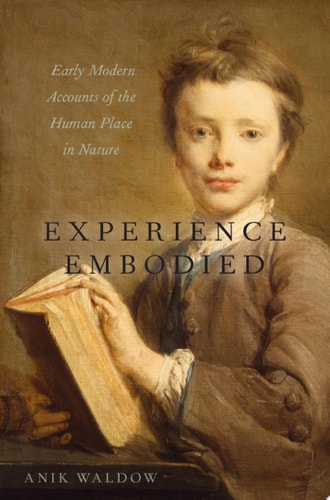
Experience Embodied: Early Modern Accounts of the Human Place in Nature
0
0
As an Amazon Associate and affiliate partner, Menrva Books earns from qualifying purchases. Learn more
Author Description
Anik Waldow develops an account of embodied experience that extends from Descartes' conception of the human body as firmly integrated into the causal play of nature, to Kant's understanding of anthropology as a discipline that provides us with guidance in our lives as embodied creatures. Waldow defends the claim that during the early modern period, the debate on experience not only focused on questions arising from the subjectivity of our thinking and feeling, it also foregrounded the essentially embodied dimension of our lives as humans. By taking this approach, Waldow departs from the traditional epistemological route dominant in treatments of early-modern conceptions of experience. She makes the case that reflections on experience took center stage in a debate that was moral in nature, because it raised questions about the developmental potential of human beings and their capacity to instantiate the principles of self-determined agency in their lives. These questions emerged for many early modern authors since they understood that the fact that humans are embodied entailed that they are similarly responsive and causally-determined like other non-human animals. While this perspective made it possible to acknowledge that humans are part of the causal dynamics of nature, it called into question their ability to act in accordance with the principles of free, rational agency. Experience Embodied reveals how early modern authors responded to this challenge, offering a new perspective on the centrality of the concept of experience in comprehending the uniquely human place in nature.
Menrva's Summary
THE THESIS
This book investigates how early modern philosophers conceptualized the human experience as an inherently embodied state within the natural world. Anik Waldow, a scholar of early modern philosophy, challenges the traditional epistemological focus of the period by arguing that thinkers were deeply concerned with the moral implications of human embodiment. She examines how authors from Descartes to Kant navigated the tension between viewing humans as causally determined biological entities and as agents capable of self-determination.
THE SCOPE MAP
What You Will Find
- Analysis of the transition from Cartesian mechanical views of the body to Kantian anthropology.
- Examination of the moral dimensions of human development and agency.
- Comparative study of human responsiveness versus non-human animal behavior.
Scope Limits
- The text does not provide a comprehensive history of all early modern philosophical schools.
- It does not focus on contemporary neuroscientific or biological theories of embodiment.
THE AUTHORITY PERSPECTIVE
Scholars recognize this work as a significant re-evaluation of early modern debates, noting its success in shifting the focus from pure epistemology to moral anthropology. Readers frequently highlight the academic density of the prose, which is intended for those with a background in philosophical history.
Page Count:
310
Publication Date:
2020-01-01
Publisher:
Oxford University Press
ISBN-10:
0190086130
ISBN-13:
9780190086138
Philosophy
Anthropology
Philosophy history
Epistemology
Philosophy Modern
Early Modern
Experience
Community Tags
Similar Books