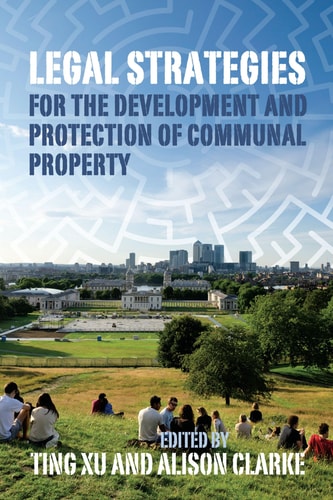
Legal Strategies for the Development and Protection of Communal Property
0
0
As an Amazon Associate and affiliate partner, Menrva Books earns from qualifying purchases. Learn more
Author Description
Whilst historically communal property has had very different meanings and functions in the UK, China, and other regions of the world, parallel developments are emerging, and modern perceptions are converging even as each region faces its own unique challenges in the management of land and natural resources. These developments have raised an important question: What legal strategies are most likely to promote the development and protection of communal property? Answers to this question will not only guide domestic debates on resource governance and community development, but also provoke global discussions and help to formulate global guidelines to address pressing challenges.Contributions to Legal Strategies for the Development and Protection of Communal Property focus on legal strategies for the development and protection of communal property as it relates to land and other natural resources, considering how these strategies 'map' over different jurisdictions (England and Wales, Scotland, South Africa, Cameroon, Italy, Israel, and China) and through different jurisprudential approaches. Legal Strategies for the Development and Protection of Communal Property looks at property beyond the traditional, individualist, and exclusive ownership model, placing the focus on communal property from different standpoints and linking the empirical perspective with the theoretical perspective. In doing so, it challenges the theory of communal property through empirical case studies, not only linking theory with practice but also linking the local with the global.
Menrva's Summary
THE THESIS
What legal strategies are most likely to promote the development and protection of communal property? Editors Alison Clarke and Ting Xu compile a series of scholarly contributions that examine the intersection of land management and legal frameworks across diverse global jurisdictions. By analyzing how communal property functions in regions ranging from China to the United Kingdom and South Africa, the authors bridge the gap between theoretical property models and empirical, on-the-ground governance challenges. The text argues for a shift away from strictly individualistic ownership paradigms toward more inclusive, communal management strategies.
THE SCOPE MAP
What You Will Find
- Comparative legal analysis across seven jurisdictions including England, Wales, Scotland, South Africa, Cameroon, Italy, Israel, and China.
- Examination of communal property management regarding land and natural resources.
- Integration of empirical case studies with jurisprudential theory.
- Frameworks for formulating global guidelines for resource governance.
THE AUTHORITY PERSPECTIVE
Experts identify this volume as a significant contribution to comparative property law, noting its utility for scholars and policymakers interested in non-individualistic ownership models. Readers frequently highlight the academic density of the prose and the breadth of the international case studies provided.
Page Count:
350
Publication Date:
2018-12-04
Publisher:
Oxford University Press
ISBN-10:
019726638X
ISBN-13:
9780197266380
Property Law
Commons
Sociology
Governance
Land tenure
Law
Academic
Community Tags
Other Editions(2)

Similar Books