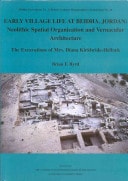
Early Village Life at Beidha, Jordan: Neolithic Spatial Organization and Vernacular Architecture: The Excavations of Mrs. Diana Kirkbride-Helbæk
0
0
As an Amazon Associate and affiliate partner, Menrva Books earns from qualifying purchases. Learn more
Author Description
This case study rigorously investigates village spatial organization and vernacular architecture of the Early Neolithic village of Beidha in southern Jordan. Around 10,000 years ago, humans began to establish farming villages in a variety of settings across Southwest Asia. Yet the changes in community social organization associated with this fundamental economic development have remained largely unexplored. This volume reveals that fundamental changes occurred over time in the built environment. Individual households became more independent and public buildings were increasingly important venues for conducting community-wide activities that served to integrate the village. This study will be of interest both to Southwest Asian archaeologists and all those interested in how early villages were formed.
Menrva's Summary
THE THESIS
This volume investigates the correlation between the evolution of vernacular architecture and the development of social organization in the Early Neolithic village of Beidha. Brian F. Byrd, an expert in Southwest Asian archaeology, utilizes the extensive excavation data collected by Diana Kirkbride-Helbæk to reconstruct the spatial dynamics of this ancient settlement. The work argues that the transition toward sedentary farming necessitated a shift in household independence and the emergence of specialized public architecture to maintain community cohesion.
THE SCOPE MAP
What You Will Find
- Detailed analysis of Neolithic spatial organization and household layout in southern Jordan.
- Examination of architectural transitions over the occupation period of Beidha.
- Synthesis of primary excavation records and site-specific archaeological data.
- Theoretical framework regarding the integration of early village communities through public spaces.
THE AUTHORITY PERSPECTIVE
Experts recognize this monograph as a foundational resource for understanding the social complexities of early sedentary societies in the Levant. Scholars frequently cite the text for its rigorous application of architectural analysis to broader anthropological questions regarding community formation.
Page Count:
466
Publication Date:
2005-08-04
Publisher:
Oxford University Press
ISBN-10:
0197270131
ISBN-13:
9780197270134
History
Architecture
Anthropology
Neolithic
Archaeology
Jordan history
Community Tags
Similar Books