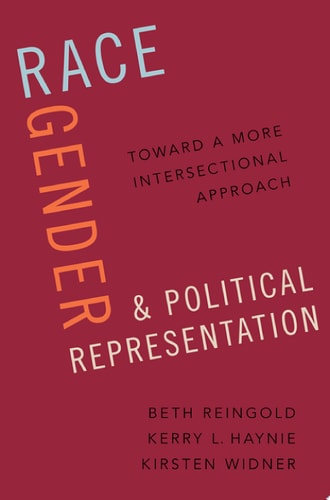
Race, Gender, and Political Representation: Toward a More Intersectional Approach
0
0
As an Amazon Associate and affiliate partner, Menrva Books earns from qualifying purchases. Learn more
Author Description
It is well established that the race and gender of elected representatives influence the ways in which they legislate, but surprisingly little research exists on how race and gender interact to affect who is elected and how they behave once in office. How do race and gender affect who gets elected, as well as who is represented? What issues do elected representatives prioritize? Does diversity in representation make a difference?Race, Gender, and Political Representation takes up the call to think about representation in the United States as intersectional, and it measures the extent to which political representation is simultaneously gendered and raced. Specifically, the book examines how race and gender interact to affect the election, behavior, and impact of all individuals. By putting women of color at the center of their analysis and re-evaluating traditional, "single-axis" approaches to studying the politics of race or gender, the authors demonstrate what an intersectional approach to identity politics can reveal. Drawing on original data on the presence, policy leadership, and policy impact of Black women and men, Latinas and Latinos, and White women and men in state legislative office in the late twentieth and early twenty-first centuries, each chapter shows how the politics of race, gender, and representation are far more complex than recurring "Year of the Woman" frameworks suggest. An array of race-gender similarities and differences are evident in the experiences, activities, and accomplishments of these state legislators. Yet one thing is clear: the representation of those marginalized by multiple, intersecting systems of power and inequality is intricately bound to the representation of women of color.
Menrva's Summary
THE THESIS
This book investigates how the intersection of race and gender influences the election, legislative behavior, and policy impact of representatives in the United States. The authors, Kerry L. Haynie, Kirsten Widner, and Beth Reingold, utilize a framework that moves beyond traditional single-axis analysis to center the experiences of women of color. By examining state legislative data from the late twentieth and early twenty-first centuries, they argue that political representation is simultaneously raced and gendered, necessitating a more complex understanding of identity politics.
THE SCOPE MAP
What You Will Find
- Quantitative and qualitative analysis of state legislative officeholders across multiple decades.
- A comparative framework evaluating the experiences of Black, Latina/o, and White legislators.
- Empirical evidence regarding policy leadership and legislative impact.
- A critique of existing "Year of the Woman" political frameworks.
THE AUTHORITY PERSPECTIVE
Scholars in political science identify this work as a significant contribution to the study of intersectionality in American governance. Readers frequently note the academic rigor of the data analysis and the clarity with which the authors challenge conventional political science paradigms.
Page Count:
248
Publication Date:
2020-01-01
Publisher:
Oxford University Press
ISBN-10:
0197502199
ISBN-13:
9780197502198
Public Policy
Sociology
Comparative Politics
American Politics
Gender Studies
Race Relations
United States
Community Tags
Similar Books