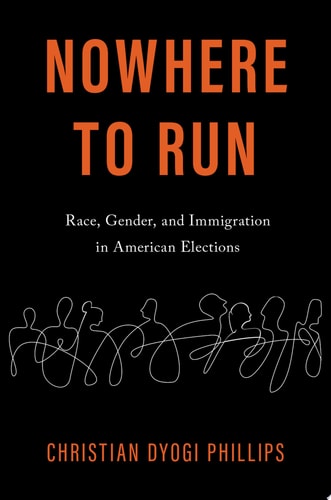
Nowhere to Run: Race, Gender, and Immigration in American Elections
0
0
As an Amazon Associate and affiliate partner, Menrva Books earns from qualifying purchases. Learn more
Author Description
Why has the underrepresentation of women and racial minorities in elected office proved so persistent? Many researchers have asserted that the main shortfall happens at the candidacy stage--women and people of color are competitive candidates, but too few throw their hat into the ring. However, these studies are animated by two assumptions that tend to speak past each other. On the one hand, gender and politics scholars often suggest that women lack sufficient ambition to run for office relative to men. On the other hand, race and politics scholars have suggested that districts with majority white populations do not provide adequate resources or opportunities for minority candidates to succeed. These approaches tend to treat women and racial minorities as parallel social groups, and fail to account for the ways in which race and gender simultaneously shape candidacy. Nowhere to Run introduces the intersectional model of electoral opportunity, which argues that descriptive representation in elections is shaped by intersecting processes related to race and gender. Across states, realistic opportunities for potential candidates of color to get on state legislative ballots are sharply circumscribed by the distribution of white majority populations in most districts; and within the districts that are most widely viewed as winnable seats--majority minority districts--the perceived scarcity of viable electoral opportunities exacerbates factors that tend to push women of color farther from the candidate pipeline. These overlapping constraints result in an electoral landscape where women of color face constraints on electoral opportunity that are intersecting and multilayered. Drawing on an original dataset encompassing nearly every state legislative general election from 1996-2015, as well as interviews and surveys with candidates, donors, and other political elites from 42 states, Nowhere to Run tests this theory with a first of its kind study of Asian American and Latina/
Menrva's Summary
THE THESIS
This book investigates why the underrepresentation of women and racial minorities in American elected office remains persistent by challenging the traditional, siloed approaches to candidacy research. Author Christian Dyogi Phillips argues that existing scholarship often treats race and gender as separate variables, failing to account for their intersectional impact on political ambition and opportunity. By introducing the intersectional model of electoral opportunity, the text demonstrates how race and gender simultaneously shape the candidate pipeline, particularly for women of color in state legislative elections.
THE SCOPE MAP
What You Will Find
- An original dataset covering nearly every state legislative general election from 1996 to 2015.
- Qualitative evidence gathered from interviews and surveys with candidates, donors, and political elites across 42 states.
- An analysis of the intersectional model of electoral opportunity as it applies to Asian American and Latina candidates.
- A detailed examination of how district demographics, specifically majority-white versus majority-minority populations, constrain candidate viability.
THE AUTHORITY PERSPECTIVE
Experts recognize this work as a significant contribution to the study of political representation, specifically for its methodological rigor in combining large-scale quantitative data with qualitative elite interviews. Readers frequently note the academic density of the prose, which serves as a foundational text for those studying the intersection of identity and electoral systems.
Page Count:
275
Publication Date:
2021-01-01
Publisher:
Oxford University Press
ISBN-10:
0197538967
ISBN-13:
9780197538968
Comparative Politics
American Politics
Elections
Sociology
Gender Studies
Community Tags
Similar Books