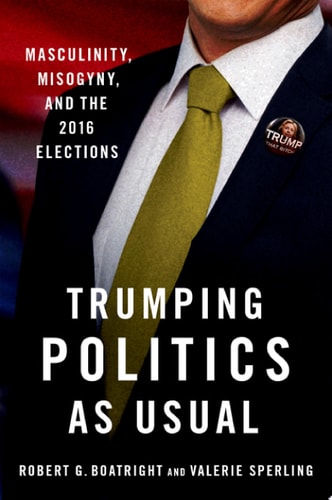
Trumping Politics as Usual: Masculinity, Misogyny, and the 2016 Elections
0
0
As an Amazon Associate and affiliate partner, Menrva Books earns from qualifying purchases. Learn more
Author Description
In many elections, candidates frame their appeals in gendered ways--they compete, for instance, over who is more "masculine." This is the case for male and female candidates alike. In the 2016 presidential election, however, the stark choice between the first major-party female candidate and a man who exhibited a persistent pattern of misogyny made the use of gender more prominent than in any previous election in the United States. Presidential campaigns often have an impact on downballot Congressional races, but the 2016 election provided a new opportunity to see the effects of misogyny. While much has been written about the 2016 election--and the shadow of 2016 clearly affected the pool of candidates in the 2018 midterms--this book looks at how the Trump and Clinton campaigns actually changed the behavior of more conventional candidates for Congress in 2016 and 2018.Over the past decade, those who study political parties have sought to understand changes in the relationship between groups and parties and how these changes have affected the ability of parties to develop coherent campaign strategies. The clear need for rapid adjustments in party strategy in the 2016 election provides an ideal means of testing whether today's political parties are more able or less able to respond to unexpected events. This book argues that Donald Trump's candidacy radically altered the nature of the 2016 congressional campaigns in two ways. First, it changed the issues of contention in many of these races. Trump's provocative calls for building a wall along the Mexican border and temporarily prohibiting immigration from Muslim countries inserted issues of race and ethnicity into elections and forced candidates to respond to his proposals. Most consequentially, however, Trump's attacks on women--including television personalities, politicians, and, at times, private citizens--alienated numerous potential supporters and placed many of his supporters (and downballot Republican candidat
Menrva's Summary
THE THESIS
How did the 2016 presidential election, characterized by overt misogyny and gendered rhetoric, fundamentally alter the campaign strategies and behaviors of downballot congressional candidates? Robert G. Boatright and Valerie Sperling utilize political science frameworks to examine the intersection of gender, party strategy, and candidate behavior. By analyzing the 2016 and 2018 election cycles, the authors argue that the Trump candidacy forced a shift in campaign discourse, compelling candidates to respond to provocative rhetoric regarding race, ethnicity, and gender. The text evaluates the capacity of political parties to adapt their strategies in the face of unexpected, high-profile electoral events.
THE SCOPE MAP
What You Will Find
- Analysis of gendered campaign rhetoric and the performance of masculinity in political contests.
- Examination of how presidential campaign narratives influence downballot congressional races.
- Assessment of party organizational responses to candidate-driven controversies.
- Comparative study of the 2016 and 2018 election cycles.
Scope Limits
- The study does not provide a comprehensive biography of the candidates involved.
- It does not offer a predictive model for future election outcomes beyond the 2018 cycle.
THE AUTHORITY PERSPECTIVE
Experts identify this work as a significant contribution to the study of political communication and gender dynamics in contemporary American elections. Readers frequently note the academic rigor of the analysis, which provides a structured look at how national political shifts impact local legislative races.
Page Count:
252
Publication Date:
2019-10-08
Publisher:
Oxford University Press
ISBN-10:
0190065826
ISBN-13:
9780190065829
Politics
Philosophy
Gender Studies
Comparative Politics
Politics & Government
Political
Elections
Elections & Political Process
Sociology
American Politics
Systems Theory
New Used & Rental Textbooks
Community Tags
Other Editions(2)
Similar Books




Reader Comments
Share Your Thoughts
No comments yet. Be the first to share your thoughts!