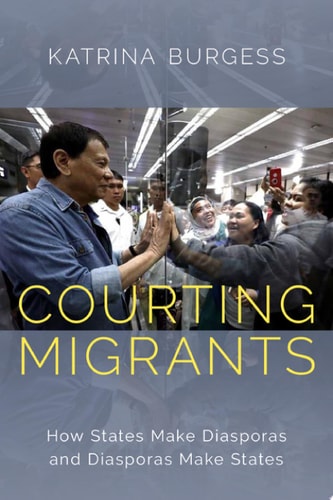
Courting Migrants: How States Make Diasporas and Diasporas Make States
0
0
As an Amazon Associate and affiliate partner, Menrva Books earns from qualifying purchases. Learn more
Author Description
Migrants have, for some time, engaged in the politics of their homelands from a distance, but, as this book argues, politicians are increasingly looking beyond their national boundaries for electoral and political support. While migrants rarely cast decisive votes in homeland elections, they are not marginal to homeland politics. Courting Migrants looks at how extraterritorial outreach by homeland states and parties alters the boundaries of political membership and intersects with migrant agency to transform politics at home. It addresses three specific questions: under what conditions and in what ways do homeland authorities reach out to migrants? How do these migrants respond? And, to what extent does their response affect homeland governance?Katrina Burgess argues that globalization and the spread of democracy since the 1970s have encouraged politicians in the Global South to reach out to migrants in search of economic resources, foreign policy support, and/or electoral advantage. They do so by cultivating feelings of loyalty that induce some kinds of migrant engagement while discouraging others. Whether or not these politicians succeed depends on where migrants are located, how many resources they have, what kinds of identities they value, and why they left their homeland in the first place. This interaction between outreach and engagement has implications, in turn, for how migrants are responding to the current wave of populism and authoritarianism around the globe. The book is based on in-depth research on state-migrant relations in four high-migration countries: Turkey, Dominican Republic, Philippines, and Mexico.
Menrva's Summary
THE THESIS
How do homeland states and political parties strategically engage with their migrant populations to influence domestic governance and political outcomes? Katrina Burgess, a scholar specializing in political economy and migration, examines the evolving relationship between states in the Global South and their diasporas. By analyzing the intersection of state outreach and migrant agency, the book argues that globalization and democratic shifts have incentivized politicians to cultivate political loyalty across national borders to secure economic resources and electoral support.
THE SCOPE MAP
What You Will Find
- Comparative analysis of state-migrant relations in Turkey, the Dominican Republic, the Philippines, and Mexico.
- A framework for understanding how extraterritorial political outreach alters the definition of national membership.
- Evaluation of how migrant identity, resource availability, and reasons for emigration dictate the success of state engagement strategies.
- Discussion on the impact of these transnational political dynamics on the rise of contemporary populism and authoritarianism.
THE AUTHORITY PERSPECTIVE
Scholars in migration studies and comparative politics identify this work as a significant contribution to understanding the transnational dimensions of statecraft. Readers frequently note the clarity of the comparative methodology and the depth of the case studies provided.
Page Count:
251
Publication Date:
2020-01-01
Publisher:
Oxford University Press
ISBN-10:
0197501818
ISBN-13:
9780197501818
Transnationalism
Transnational voting
Sociology
Globalization
Comparative Politics
Migration Studies
International relations
Immigrants
Public Policy
Community Tags
Other Editions(2)
Similar Books