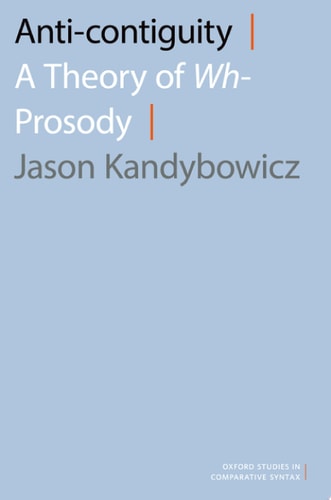
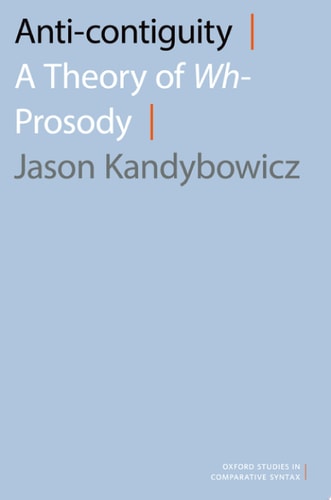
Anti-contiguity: A Theory of Wh- Prosody
0
0
As an Amazon Associate and affiliate partner, Menrva Books earns from qualifying purchases. Learn more
Author Description
A recent wave of research has explored the link between wh- syntax and prosody, breaking with the traditional generative conception of a unidirectional syntax-phonology relationship. In this book, Jason Kandybowicz develops Anti-contiguity Theory as a compelling alternative to Richards' Contiguity Theory to explain the interaction between the distribution of interrogative expressions and the prosodic system of a language. Through original and highly detailed fieldwork on several under-studied West African languages (Krachi, Bono, Wasa, Asante Twi, and Nupe), Kandybowicz presents empirically and theoretically rich analyses bearing directly on a number of important theories of the syntax-prosody interface. His observations and analyses stem from original fieldwork on all five languages and represent some of the first prosodic descriptions of the languages. The book also considers data from thirteen additional typologically diverse languages to demonstrate the theory's reach and extendibility.Against the backdrop of data from eighteen languages, Anti-contiguity offers a new lens on the empirical and theoretical study of wh- prosody.
Menrva's Summary
THE THESIS
How does the interaction between wh- syntax and prosody function, and can Anti-contiguity Theory provide a more robust explanation than existing models? Jason Kandybowicz, a specialist in syntax and African linguistics, utilizes original fieldwork to challenge the traditional generative view of a unidirectional syntax-phonology relationship. He proposes Anti-contiguity Theory as a framework to account for the distribution of interrogative expressions, arguing that prosodic constraints play a more active role in syntactic structure than previously acknowledged.
THE SCOPE MAP
What You Will Find
- Detailed prosodic descriptions of Krachi, Bono, Wasa, Asante Twi, and Nupe.
- A comparative analysis of wh
- prosody across eighteen typologically diverse languages.
- A formal critique and alternative to Richards' Contiguity Theory.
- Methodological insights derived from primary linguistic fieldwork in West Africa.
THE AUTHORITY PERSPECTIVE
Experts recognize this work as a significant contribution to the syntax-prosody interface, particularly for its inclusion of previously under-studied West African languages. Readers frequently note the technical density of the prose, which is intended for advanced students and researchers in theoretical linguistics.
Page Count:
176
Publication Date:
2020-01-01
Publisher:
Oxford University Press
ISBN-10:
0197509762
ISBN-13:
9780197509760
Linguistics
Academic
English & College Success
English
Syntax
World Languages
Phonology
Reference
Community Tags
Other Editions(3)
Similar Books