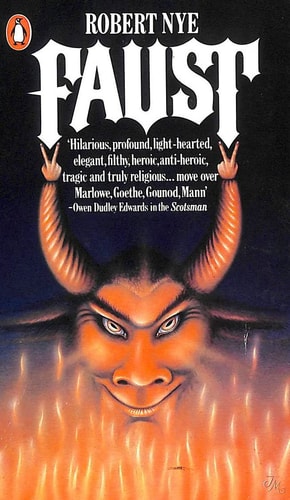
Faust
0
0
As an Amazon Associate and affiliate partner, Menrva Books earns from qualifying purchases. Learn more
Author Description
Faust was for the popular imagination the embodiment of the adventurous spirit of the time, straddling the Middle Ages and modern times. In his book, Robert Nye uses historical documents that attest to the existence of Faust by throwing some light on his personality, by mixing in the elements of a hilarious romantic fiction. The book presents itself as the diary of Christophe Wagner, the young disciple of the alchemist, who takes us on a hair-raising pilgrimage to Rome following an unexpected Faust, an inveterate drunkard, a debauched and vicious knight of industry. Also on the trip are Hélène de Troie, mistress of the mage, ugly pain in the ass, mythomaniac and mystic, as well as seven lovely young girls, each practicing a different erotic specialty for the benefit of this young bawdy Wagner. Also cross the story Henry VIII, Luther, Margaret of Navarre, Calvin, etc. Fascinating like a whodunnit, joyously obscene like a contemporary Rabelais, Robert Nye's Faust is one of those works from which you come out with the impression of being more intelligent.
Menrva's Summary
THE PULSE
The narrative follows the chaotic pilgrimage of the alchemist Faust and his disciple, Christophe Wagner, as they traverse Europe amidst the religious and political upheavals of the sixteenth century. Christophe Wagner serves as the primary observer, documenting the erratic behavior of his mentor, Faust, who is portrayed as a debauched, drunken, and opportunistic figure. The pair, accompanied by a troupe of women including Hélène de Troie, navigate a landscape populated by historical figures such as Martin Luther and Henry VIII. The narrative framework relies on the conceit of a personal diary, which captures the absurdity and moral ambiguity of their encounters. The characters operate within a world defined by the collision of medieval superstition and the emerging intellectual shifts of the Renaissance.
INSIDE THE PAGES
- Epistolary narrative structure presented as the diary of Christophe Wagner.
- Integration of historical figures including Martin Luther, John Calvin, and Henry VIII.
- Satirical tone reminiscent of Rabelaisian humor.
- Exploration of the intersection between alchemy and early modern science.
- Picaresque plot progression through various European locales.
- Inclusion of mythological and historical archetypes like Hélène de Troie.
- Explicit and bawdy thematic content regarding the characters' appetites.
- Blending of documented historical facts with fictionalized character studies.
THE COLLECTIVE ECHO
Discussion often centers on the author's ability to subvert the traditional Faustian legend by presenting a protagonist who is fundamentally flawed and unheroic. Readers frequently highlight the prose style, which balances intellectual rigor with a coarse, irreverent humor that keeps the pacing brisk. Critics note that the inclusion of historical figures serves to ground the fantastical elements in a recognizable, albeit distorted, reality. The work is often evaluated for its commentary on the nature of ambition and the human condition during a period of significant cultural transition. Many readers find the juxtaposition of high-minded philosophy and base physical appetites to be the defining characteristic of the reading experience.
Page Count:
1
Publication Date:
1986-01-22
Publisher:
Penguin
ISBN-10:
014005815X
ISBN-13:
9780140058154
Fiction
Historical Fiction
Fantasy
Satire
Picaresque
Contemporary
Community Tags
Similar Books