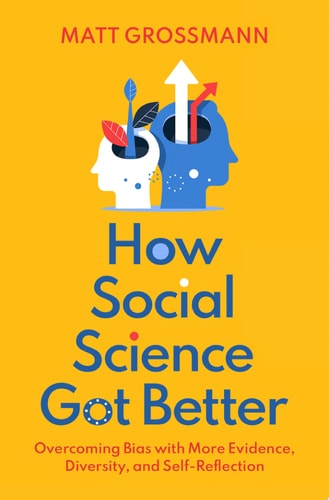
How Social Science Got Better: Overcoming Bias with More Evidence, Diversity, and Self-Reflection
0
0
As an Amazon Associate and affiliate partner, Menrva Books earns from qualifying purchases. Learn more
Author Description
It seems like most of what we read about the academic social sciences in the mainstream media is negative. The field is facing mounting criticism, as canonical studies fail to replicate, questionable research practices abound, and researcher social and political biases come under fire. In response to these criticisms, Matt Grossmann, in How Social Science Got Better, provides a robust defense of the current state of the social sciences. Applying insights from the philosophy, history, and sociology of science and providing new data on research trends and scholarly views, he argues that, far from crisis, social science is undergoing an unparalleled renaissance of ever-broader understanding and application. According to Grossmann, social science research today has never been more relevant, rigorous, or self-reflective because scholars have a much better idea of their blind spots and biases. He highlights how scholars now closely analyze the impact of racial, gender, geographic, methodological, political, and ideological differences on research questions; how the incentives of academia influence our research practices; and how universal human desires to avoid uncomfortable truths and easily solve problems affect our conclusions. Though misaligned incentive structures of course remain, a messy, collective deliberation across the research community has shifted us into an unprecedented age of theoretical diversity, open and connected data, and public scholarship.Grossmann's wide-ranging account of current trends will necessarily force the academy's many critics to rethink their lazy critiques and instead acknowledge the path-breaking advances occurring in the social sciences today.
Menrva's Summary
THE THESIS
How does contemporary social science address the challenges of replication, bias, and institutional criticism to improve its overall rigor? Matt Grossmann, a political scientist and director of the Institute for Public Policy and Social Research, synthesizes historical data and sociological trends to argue that the field is currently experiencing a period of significant advancement. He posits that rather than being in a state of terminal decline, social science has become more self-reflective and methodologically diverse by actively confronting its own systemic blind spots.
THE SCOPE MAP
What You Will Find
- Analysis of research trends and scholarly shifts in the social sciences over recent decades.
- Examination of how racial, gender, and ideological diversity influences the formulation of research questions.
- Evaluation of academic incentive structures and their impact on data transparency and replication.
- Discussion of the role of public scholarship and collective deliberation in correcting historical biases.
THE AUTHORITY PERSPECTIVE
Experts view this work as a necessary counter-narrative to the prevailing skepticism surrounding academic research. Readers frequently note that the text provides a balanced, evidence-based defense of the social sciences that is accessible to both academics and informed laypeople.
Page Count:
340
Publication Date:
2021-01-01
Publisher:
Oxford University Press
ISBN-10:
0197518990
ISBN-13:
9780197518991
Methodology
Social Science
Sociology
Research Methods
Academic Research
Community Tags
Similar Books