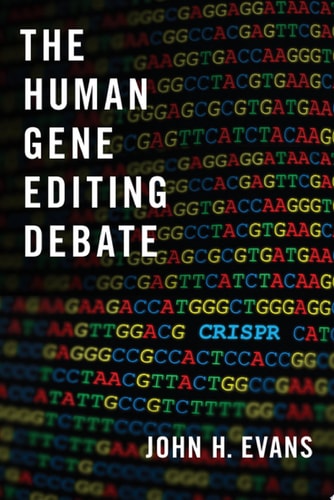
The Human Gene Editing Debate
0
0
As an Amazon Associate and affiliate partner, Menrva Books earns from qualifying purchases. Learn more
Author Description
In 2018 the first genetically modified babies were reportedly born in China, made possible by the invention of CRISPR technology in 2012. This controversial advancement overturned the pre-existing moral consensus, which had held for over fifty years before: while gene editing an adult person was morally acceptable, modifying babies, and thus subsequent generations, crossed a significant moral line. If this line is passed over, scientists will be left without an agreed-upon ethical limit. What do we do now?John H. Evans here provides a meta-level guide to how these debates move forward and their significance to society. He explains how the bioethical debate has long been characterized as a slippery slope, with consensually ethical use at the top, nightmarish dystopia at the bottom, and specific agreed-upon limits in between, which draw the lines between the ethical and the unethical. Evans frames his analysis around these limits, or barriers. Historically they have existed to guide scientists and to prevent the debate from slipping down the metaphorical slope into unacceptable eugenicist possibilities, such as in Aldous Huxley's novel Brave New World or the movie Gattaca. Evans examines the history of how barriers were placed, then fell, then replaced by new ones, and discusses how these insights inform where the debate may head. He evaluates other proposed barriers relevant to where we are now, projects that most of the barriers suggested by scientists and bioethicists will not hold, and cautiously identifies a few that could serve as the moral boundary for the next generation. At a critical time in this new era of intervention in the human genome, The Human Gene Editing Debate provides a necessary, comprehensive analysis of the conversation's direction, past, present, and future.
Menrva's Summary
THE THESIS
How can society establish and maintain ethical boundaries for human gene editing in the wake of rapidly advancing CRISPR technology? John H. Evans, a scholar in the sociology of bioethics, investigates the historical and conceptual frameworks that have governed genetic research. He argues that the traditional 'slippery slope' model of bioethics is failing, necessitating a new meta-level analysis of how moral barriers are constructed, dismantled, and replaced in the face of scientific progress.
THE SCOPE MAP
What You Will Find
- Historical analysis of the fifty-year moral consensus regarding human germline modification.
- A meta-level framework for understanding how bioethical debates evolve over time.
- Evaluation of proposed moral barriers against eugenicist outcomes and dystopian scenarios.
- Projections on the viability of current and future ethical limits for genetic intervention.
THE AUTHORITY PERSPECTIVE
Experts recognize this work as a vital contribution to the sociology of science, providing a clear-eyed assessment of the limitations inherent in current bioethical discourse. Readers frequently note the clarity of the author's prose, which makes complex regulatory and philosophical arguments accessible to both scientific professionals and the general public.
Page Count:
210
Publication Date:
2020-01-01
Publisher:
Oxford University Press
ISBN-10:
019751958X
ISBN-13:
9780197519585
Science
History
Philosophy
Bioethics
Sociology of Health
Reproductive Technology
Genetics
Medical
Allied Health
Technology
Family & Consumer Sciences
Sociology
Community Tags
Other Editions(3)


Similar Books







Reader Comments
Share Your Thoughts
No comments yet. Be the first to share your thoughts!