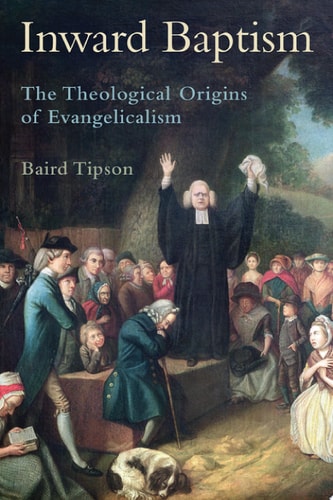
Inward Baptism: The Theological Origins of Evangelicalism
0
0
As an Amazon Associate and affiliate partner, Menrva Books earns from qualifying purchases. Learn more
Author Description
Inward Baptism analyses the theological developments that led to the great evangelical revivals of the mid-eighteenth century. Baird Tipson here demonstrates how the rationale for the "new birth," the characteristic and indispensable evangelical experience, developed slowly but inevitably from Luther's critique of late medieval Christianity.Addressing the great indulgence campaigns of the late fifteenth and early sixteenth centuries, Luther's perspective on sacramental baptism, as well as the confrontation between Lutheran and Reformed theologians who fastened on to different aspects of Luther's teaching, Tipson sheds light on how these disparate historical moments collectively created space for evangelicalism. This leads to an exploration of the theology of the leaders of the Evangelical awakening in the British Isles, George Whitefield and John Wesley, who insisted that by preaching the immediate revelation of the Holy Spirit during the "new birth," they were recovering an essential element of primitive Christianity that had been forgotten over the centuries. Ultimately, Inward Baptism examines how these shifts in religious thought made possible a commitment to an inward baptism and consequently, the evangelical experience.
Menrva's Summary
THE THESIS
This book investigates the theological evolution of the "new birth" concept and its role in the emergence of eighteenth-century evangelical revivals. Baird Tipson utilizes historical analysis to trace the development of evangelical thought from Martin Luther's critiques of late medieval Christianity through the theological debates between Lutheran and Reformed traditions. By examining the shift from sacramental baptism to the emphasis on immediate spiritual revelation, the author provides a framework for understanding the intellectual foundations of the Evangelical awakening led by figures such as George Whitefield and John Wesley.
THE SCOPE MAP
What You Will Find
- Analysis of late medieval indulgence campaigns and their impact on religious reform.
- Examination of the theological confrontation between Lutheran and Reformed perspectives on baptism.
- Historical documentation of the transition toward the "new birth" as a central evangelical experience.
- Evaluation of the preaching and theological claims of George Whitefield and John Wesley.
THE AUTHORITY PERSPECTIVE
Scholars and historians of religion frequently cite this work for its precise tracing of complex theological lineages within the Protestant tradition. Readers often note the academic density of the prose, which serves as a rigorous examination of the intellectual shifts that defined the Evangelical movement.
Page Count:
219
Publication Date:
2020-01-01
Publisher:
Oxford University Press
ISBN-10:
019751149X
ISBN-13:
9780197511497
History
Religion
Theology
Evangelicalism
Christianity
Theology doctrinal
Community Tags
Similar Books